Chemistry Built for the Pulse: How AI and Batteries are Redefining the UPS
Key Highlights
- AI workloads demand power infrastructure that can respond in milliseconds to micro spikes and macro swings, challenging legacy UPS designs.
- Proximity of energy storage to the load reduces distribution losses and improves response times, essential for high-density AI environments.
- Evolving battery chemistries like nickel-zinc provide fast recharging, high power density, and safety, making them ideal for active load stabilization.
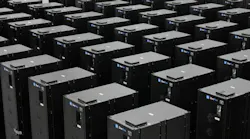
Since the inception of the modern data center, the uninterruptible power supply (UPS) has had one job everyone agreed on: Hold the load when the grid drops, cover the seconds it takes for generators to start, and stay quiet the rest of the time. Data center teams sized it around that single moment and moved on. Fast forward to 2026, and AI has changed the assignment.
AI racks are climbing past 100 kW and heading toward a megawatt. GPU clusters draw power in a way that looks nothing like traditional IT. On a micro scale, they ramp from idle to peak and back in milliseconds, thousands of times an hour, often in sync across an entire training run.
On a macro scale, large facilities can swing up and down faster than local utilities can manage. The load profile is an ever-changing combination of macro swings and sharp, repeated micro spikes, or graphic processing unit (GPU) transients. The room-scale, double-conversion UPS that most facilities run still does its job. It holds the load and rides through the outage. It was never built for absorbing those repeated swings hour after hour, and that mismatch will only compound as density climbs.
Chasing milliseconds with more cabinets
A topology engineered for steady demand will struggle to carry variable AI workloads at scale, and operators today tend to paper over the gap the only way legacy design allows – they overbuild. More capacity. More headroom. More cabinets standing by for a peak that lasts a fraction of a second or a swing that comes a handful of times a day. That approach scales cost faster than it scales protection.
Every cabinet added to chase a transient is floor space that could hold revenue-generating compute, plus the cooling and service that trail behind it.
The workloads arriving now ask for three things of power infrastructure:
● Energy has to arrive at higher voltage to move more power through the same copper.
● Storage has to respond in milliseconds, fast enough to catch a spike at its leading edge. Yet have enough energy density to manage macro load swings.
● And it has to sit close to the compute it protects, where distribution loss is small and response is immediate.
Each requirement pulls power out of the central plant and moves it closer to the rack as proximity to the source will be key in reducing overbuild.
From backup to active stabilization
This is where energy storage has to evolve from passive backup into active stabilization, and where the UPS may go to die as the market explores alternative systems like in-rack BBU and powered side car designs. Regardless, a high-rate battery paired with a fast-response system absorbs the pulse at the source, shaping demand before it ripples through the facility and out to the grid. The same system still
covers the outage and macro load swings. One footprint, two functions, and no separate stack of supercapacitors bolted on to handle what the UPS batteries could not, and no GWh-scale BESS system out back consuming unnecessary footprint and CAPEX.
That reach past the fence line matters more every quarter. In power-constrained regions, how a site behaves at the point of interconnection shapes how fast it gets permitted, let alone built. Large, unmanaged swings can strain the local grid and stretch interconnection timelines. A facility that smooths its own demand internally becomes an easier neighbor for the utility, and often a faster project to permit and approve. Not only that, but choosing the right chemistry can improve permitting times by 2x to 3x.
Chemistry built for the pulse
Nickel-zinc (NiZn) battery technology was built for high-power, high-frequency cycling – the exact duty an AI load imposes – and it carries more energy density than supercapacitor designs. It delivers peak power even at low states of charge, recharges fast, and does not carry the thermal-runaway risk that forces lithium-ion into heavy fire suppression and standoff distances, reducing permitting time substantially over thermal runaway prone chemistries. That safety profile is what lets the storage live next to the load instead of quarantined across the room.
My company, ZincFive, designed the BC 2 AI UPS Battery cCabinet around this idea: load smoothing and ride-through in one nickel-zinc cabinet, with pulse intelligence built into the battery management system. High power density keeps the footprint tight, which matters when white space is the thing operators sell. Fewer cabinets covering the same power pulls down total cost across cooling, installation, and the decade of operation that follows. And with a warranty designed specifically for pulsed duty, operators gain additional confidence in long-term performance.
This is the thinking behind the ZincFive BC 2 AI UPS Battery Cabinet. We built it for this exact environment, a single nickel-zinc cabinet that smooths AI power pulses during normal operation and carries the full load through an outage. Pulse-power intelligence sits in the battery management system, and the cabinet ships with a warranty written for pulsed duty and ongoing service support to keep the system at peak capacity. It handles both jobs in one footprint, so operators can stop stacking separate systems to solve two halves of the same problem.
The measure has changed
The UPS is being redefined while it runs, and maybe even removed entirely as we progress. Its old measure was minutes of runtime.
The new measure is how cleanly it absorbs a pulse and still covers the outage and how close to the GPU it can sit. Storage that does both, sitting close to the rack, and supporting highly variable workloads, is what separates the data centers that scale with AI from the ones still writing checks for capacity they rarely touch.
EnergyTech: Voice of the Commercial & Industrial Energy User
Follow us on LinkedIn
About the Author
Brandon Smith
Brandon Smith is vice president of global sales and product at battery chemistry firm ZincFive.