AI Data Centers Mark the End of Traditional Grid Assumptions
Key Highlights
- AI training data centers demand unprecedented power capacity, often between 1,000 to 7,000 MW, surpassing traditional data center loads.
- Traditional grid connections are insufficient due to scale, timing, and planning limitations, leading to a shift toward onsite, islanded power systems.
- Onsite power islands give developers control over their energy supply, but require complex planning, coordination, and high-level automation solutions.
Around the world, new data centers are emerging to support the rise of artificial intelligence (AI) technology. Yet modern data centers, including those designed for AI training, are a fundamentally new class of energy customer that existing grids were not designed to support.
AI-training data centers represent an unprecedented surge in power demand and volatility. New campuses anticipate 1,000 to 7,000 megawatts (MW) of usage, compared to the 50 to 100 MW of traditional large data centers. Moreover, they must come online quickly to capitalize on the current AI demand. This shift has pushed data center developers toward a new reality: controlling their own power destiny is critical for speed to power.
Traditional grid connection no longer works
Scale, timing, and planning limitations of traditional grid interconnections are simply not at the level necessary to support AI-training data center operations. Removing the required magnitude of load from the bulk electrical system could create system-wide impacts, some of which have the potential to be severe and dangerous to the overall system.
As a result, utilities must perform careful studies of grid capability before approving the interconnection of these projects. However, the rise of AI has happened extremely quickly, and most utilities do not have the capacity to perform such studies—and perform any required grid upgrades—on a timeline that meets the needs of data center investors, owners, and operators.
Many utilities report that full interconnection study queues, approval processes, and grid upgrades can take three to four years. Developers cannot afford to wait; every year of delay equates to massive opportunity loss.
The rise of the power island
To address this issue, a new power strategy has risen in parallel with the rapid buildout of data centers: onsite, islanded power systems. Building onsite generation allows AI-training data center developers to control their own path forward and meet their challenging schedules, but it also shifts responsibility for generation, controls, protections, and reliability directly onto the project developers.
This challenge is a critical one to navigate. Power islands are complex, high-stakes systems that must be planned carefully from the start. Project teams must be agile and coordinated, and ready for the constraints such a strategy will bring.
Constrained supply chains
One of the primary constraints that arises as data center project teams pursue islanded generation is the limited availability of power generation equipment. Access to gas turbines, reciprocating engines, fuel cells, and large transformers is increasingly limited. In fact, it is common for new gas turbines to have lead times of five to seven years, far too long for a data center developer looking to capitalize on today’s booming market. Rising costs are an additional factor, with turbine prices headed toward $600 per kilowatt by the end of 2026, a 195% jump from 2019. The time to act is now.
Too many stakeholders, too little time
Project teams looking to build out islanded power facilities also face significant coordination challenges. AI data center power projects typically involve a large and diverse stakeholder group, including project developers; owner’s engineers; engineering, procurement, and construction (EPC) contractors; electrical control suppliers; battery energy storage system (BESS) and inverter providers; protection system suppliers; and electrical system analysts. Coordinating communication and collaboration among these groups is challenging even in optimal circumstances. In a compressed timeline, that coordination becomes prohibitively complex using traditional project models.
The core challenge is that traditional linear communication paths from developer to EPC to original equipment manufacturer (OEM) back to EPC and then back to the developer are far too slow. Teams need a new engagement model, one that leverages a single, trusted source to cut through the complexity.
Early, collaborative engagement is no longer optional
To drive success in AI data center power projects, traditional project sequencing must be replaced with parallel collaboration. Today’s forward-thinking developers are convening all core stakeholders early in the process, with initial commercial engagements used to align expectations, constraints, and responsibilities.
Under this model, teams focus on early identification of what each supplier needs, where system boundaries lie, and how interfaces are defined. This approach creates a shared understanding before detailed engineering begins, dramatically improving the likelihood of success and meeting aggressive project schedules.
However, one other core component is necessary to make such a strategy work: a project champion and coordinator. Today’s most effective project teams are leaning into their automation solutions provider to fill that role.

A Critical Integrator for Realistic Project Planning
An automation solutions provider with a wide range of proven solutions is the ideal neutral, experienced orchestrator for AI data center power projects. The most trusted automation solutions providers bring decades of energy industry and power system expertise. Having completed thousands of energy sector projects across many different types and strategies, these teams inherently understand how generation types behave, and are deeply familiar with the strengths, limitations, and failure modes of a wide variety of solutions.
When project teams engage their automation solutions provider early, the provider can use its deep expertise to create a critical communications layer, helping facilitate and coordinate OEMs that might not normally work together, or that normally work solely within their own small piece of the puzzle. The chain of communication gains a central hub, helping ensure every participant can operate faster and more effectively.
Navigating the Load Challenge
One example of a situation in which thoughtful guidance from an expert automation solutions provider is helpful is the unique operational stress created by AI training centers. AI training workloads are volatile, with expansive banks of processors swinging up and down multiple times per minute, creating load changes conventional generation cannot tolerate. If the loads are not properly managed, rapid torque changes can damage mechanical components and cause failures of critical generation.
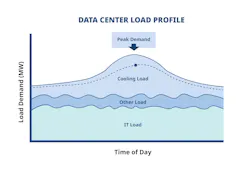
Traditional power generation systems were never designed for this kind of operation. Fortunately, properly deployed modern BESS solutions can help absorb the load shock, shielding conventional generation from violent load changes. However, implementing such a system is complex, with control coordination critical. The lowest-level mitigation must happen extremely fast, below the main control system and inside the inverter controls.
As the BESS power is rapidly charging and discharging, the energy management control system must steer the overall BESS state-of-charge, ensuring it can maintain responsiveness, while simultaneously supporting load balancing and frequency management over the longer horizon. Surrounding everything is the conventional control of all the support systems which keep the equipment healthy, control emissions, protect critical equipment, and, most importantly, ensure safety of personnel. All these elements make for a very complex and dynamic system which is most effectively deployed with a holistic automation framework.
Successfully engineering and delivering this complexity requires high-level orchestration. These types of projects require multiple areas of expertise, including ultra-fast inverter-level control, electrical and balance-of-plant control, power management, energy management, and supervisory control and data acquisition. In addition, multi-vendor generation assets must all behave as a unified system. The most experienced automation solutions providers not only provide the single, cohesive automation platform necessary to accomplish this, they also deliver the vision and expertise to provide visibility across the entire value chain.
Strategy is the Foundation of Speed
With data center projects, power islands, BESS, and advanced automation are no longer optional, but are instead prerequisites for success. However, they also increase complexity. Developers who engage experienced automation and energy partners early move faster and with less risk, leveraging a foundation of industry expertise to unlock parallel project streams, improved collaboration, and better overall orchestration.
In the race for data center delivery, speed matters, and only sustainable, well-architected systems will win.
About the Author
James Nyenhuis
James Nyenhuis is manager of performance consulting for the power industry at Emerson. Jim has extensive experience in power plant operations, control, process design, performance analysis and simulation. In his current role, Jim conducts automation performance assessments for commercial power generation facilities. He is responsible for benchmarking and control performance analysis services, delivery of technical studies including dynamic process and control analysis, lifecycle assessments of fleet-wide automation infrastructure and economic analysis of proposed automation improvements. Jim has a Bachelor of Science in mechanical engineering from the University of California, San Diego.