Rethinking How Energy and Infrastructure are Done: The AI Paradigms and the Built Environment

Time must be moving fast when the Information Age feels like the good old days when mister, we could use a man like Claude Shannon again. (Editor’s Note: I was today years old when I learned that Claude Shannon was a very important figure in 20th century computer science).
The pace of Moore’s Law raced fast enough to boggle the collective mind as analogue shifted to digital almost before we could make sense of it. The days crawl and the years fly.
Strap in and get ready for something even faster. Artificial intelligence and its impact on what might be the Fourth Industrial Revolution are now detailed in breathless tones, trying to capture in moments the movement of nanoseconds.
We’re exhausted, or so we think, and the race is just beginning. If the hype is only fractionally correct, AI stands ready to wipe clean and redraw the way we do everything, from coding to repairing to entertainment to building towers, energizing our economic growth and yet leave us in uncertainty trying to sustain our environment in a way that might preserve the future for our children and beyond.
AI gets physical at the project site

Industrial AI holds those threats and promises together in equal measure within the public mind. Can it destroy us? Can it save us?
The answer may be yes and yes. AI holds a tidal wave of digitally infused power to sweep away the old, but what if it offers in building the new may deliver incredible potential to save us from the forced errors of past project development.
“Next-generation AI infrastructure is a new paradigm, and it’s being engineered with aerospace-level rigor,” said Mahesh Deshpande, AI factory engagement strategist and global senior director of high-tech industry at French industrial AI software company Dassault Systèmes.
“It’s a system of systems, like an aircraft and it demands that discipline,” he added.
Looking to the skies makes sense for someone with Dassault Systèmes. The company began 45 years ago with a bunch of engineers and drafters embracing the next-gen 3D design tools in the aerospace industry. Dassault today is global with thousands of employees and partnering with Industrial Compute Age beacons such as NVIDIA, OMRON, Vertiv and Quanta.
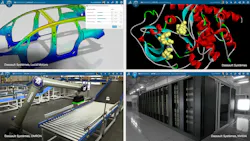
Nine months ago, Dassault announced it was integrating its in-house Virtual Twin technology with NVIDIA’s AI architecture to create shared industrial software and AI across sectors.
Virtual twins are different things than the well-known digital twins, the latter of which is a software and machine learning tool to document a facility’s operations and then utilize that for predictive maintenance and other benefits. A virtual twin takes an entirely different approach: it breaks down the silos of traditional project development from the outset and integrates every phase around design intent, combining system and scientific models with learning from operational data.
These tools can be game changers not only for building AI factories, but also power plants energizing that digital infrastructure. It all starts with AI, and AI changes everything in progressive methodology and project process for how things are built for long-term efficiency. This holds true for utility power plants, distributed energy systems and microgrids as well as any facility.
“The ecosystem needs to rethink the way AI data systems are designed and operated,” Deshpande told EnergyTech.com in an exclusive interview. “The virtual twin becomes a blueprint to help infrastructure providers bring design into standardization and gives co-location players a compelling starting point, instead of one-off snowflakes.”
The microgrid and distributed energy worlds get that phrasing. The industry leaders are fond of saying, “If you’ve seen one microgrid … you’ve seen one microgrid.” This joke is more like an admission of the specialization required in developing each different microgrid, a peculiarity that breeds cost and design uncertainties, as well as challenges to commissioning, operations and maintenance success.
Standardization and modularity are something that commercial and industrial energy project developers have been chasing for years, including seasoned microgrid veterans such as Schneider Electric, ERock, PowerSecure and others. They may have found their sword-in-the-stone tool in AI.
Pivotal moment in human history: Fear and faith in change
Google parent Alphabet's CEO Sundar Pichai has said that “AI is more profound than fire or electricity and that “AI is one of the most important things humanity is working on.”
AI is scary like fire and dangerous like electricity but provides promise to aid humanity in ways both of those do, also. Where AI promises “vive la difference” more than any other technology is its ability to instantaneously unite formerly siloed pieces of information, from the highest to the lowest and everywhere in between.
The things that AI theoretically can help make better include not only AI factories, but also cooling systems, electricity generation and manufacturing efficiencies. If you don’t utilize it, someone else will and then suddenly your project is as timely as the rotary phone, typewriter or steam locomotive.
“With billions in capex (capital expenditures), the decisions AI generates must be grounded in science,” Deshpande said. “At the highest level you get more accurate physical behaviors and fluidic phenomena. You can perform simulations that give science-based predictability.”
Every day delayed in bringing a project from design to commissioning cost millions of dollars per change in the calendar. Barriers to completing an AI factory might cost $8 million per day in lost revenue.[DM3]
“The time to first token: that’s critical for revenues,” he added.
All previous challenges sometimes arose expensively with construction already underway. Now they can be seen by AI and assessed at the design phase. All the data altogether at the same time; you can't get much more energy efficient than that.
“Earlier it was a throw-it-over-the-wall type of thing,” Deshpande said.
The Dassault Systèmes and NVIDIA collaboration combines virtual twinning with open AI models, infrastructure and accelerated software libraries to build out science-validated systems modeling and virtual expert insight. The two companies called this a potential foundation for Industrial AI.
About the Author
 Rod Walton, EnergyTech Managing Editor
Rod Walton, EnergyTech Managing Editor
Managing Editor
For EnergyTech editorial inquiries, please contact Managing Editor Rod Walton at [email protected].
Rod Walton has spent 17 years covering the energy industry as a newspaper and trade journalist. He formerly was energy writer and business editor at the Tulsa World. Later, he spent six years covering the electricity power sector for Pennwell and Clarion Events. He joined Endeavor and EnergyTech in November 2021.
Walton earned his Bachelors degree in journalism from the University of Oklahoma. His career stops include the Moore American, Bartlesville Examiner-Enterprise, Wagoner Tribune and Tulsa World.
EnergyTech is focused on the mission critical and large-scale energy users and their sustainability and resiliency goals. These include the commercial and industrial sectors, as well as the military, universities, data centers and microgrids. The C&I sectors together account for close to 30 percent of greenhouse gas emissions in the U.S.
He was named Managing Editor for Microgrid Knowledge and EnergyTech starting July 1, 2023
Many large-scale energy users such as Fortune 500 companies, and mission-critical users such as military bases, universities, healthcare facilities, public safety and data centers, shifting their energy priorities to reach net-zero carbon goals within the coming decades. These include plans for renewable energy power purchase agreements, but also on-site resiliency projects such as microgrids, combined heat and power, rooftop solar, energy storage, digitalization and building efficiency upgrades.