New Partnership Spurs Prospective AI Campus in Permian Basin
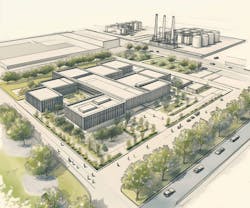
Integrated power and data center developer New Era Energy & Digital is going to partner with investment platform Primary Digital Infrastructure on building hyperscale computing facilities within the natural gas-rich Permian Basin.
Together, New Era and Primary Digital plan to co-develop the Texas Critical Data Centers project. The anticipated 1-GW hyperscale campus is designed to be connected with both grid and behind-the-meter electricity generation solutions.
First phase of the Texas Critical Data Centers (TCDC) initiative will be near Odessa in west Texas. The end goal is to attract a hyperscale anchor tenant in the cloud-based and artificial intelligence sectors of digital infrastructure.
“The next wave of hyperscale and AI infrastructure is being built where power is abundant, flexible, and economically advantaged,” said Bill Stein, executive managing director and chief investment officer at Primary Digital Infrastructure, in a statement. “This tactical co-development project exemplifies that shift while aligning with our strategy of building portfolios of high quality, risk-mitigated data center assets that are critical to tomorrow’s digital economy.”
The TCDC plan is not brand new. One year ago, New Era (called New Era Helium at the time) announced a partnership with Sharon AI to jointly develop the AI-enabled digital campus.
New Era rebranded and then acquired Sharon AI's 50% ownership stake in the TCDC project late last year.
New Mexico Attorney General Raul Torrez late last year filed a state lawsuit against New Era and CEO E. Will Gray, alleging fraud and environmental infractions by the company. New Era stock plummeted after the legal action, although the company responded by calling Torrez's filing "baseless" and an "uninformed attack" without merit.
Adequate power capacity for rising AI and cloud-based computer demand is a key concern for the U.S. and world these days. Some forecasts are predicting an added 125 GW or more of data center demand coming online by the early 2030s.
The Permian Basin is a prolific oil and gas play in geologic formations of west Texas and eastern New Mexico. The region is responsible for most of the U.S. crude oil production and averages more than 20 billion cubic feet per day of gross natural gas withdrawals, according to the federal Energy Information Administration.
The accelerated pace of AI and cloud-based computing capacity is pushing hyperscalers such as Meta and Google to consider power purchase agreements beyond renewable energy virtual PPAs. Those companies and fellow hyperscalers including Microsoft are pursuing baseload generation including future nuclear and natural gas generation.
Data Center Power will be Front and Center
at Microgrid Knowledge Conference 2026
May 4-6 at the Renaissance SeaWorld in Orlando
About the Author
EnergyTech Staff
Rod Walton is head of content for EnergyTech.com. He has spent 17 years covering the energy industry as a newspaper and trade journalist.
Walton formerly was energy writer and business editor at the Tulsa World. Later, he spent six years covering the electricity power sector for Pennwell and Clarion Events. He joined Endeavor and EnergyTech in November 2021.
He can be reached at [email protected].
EnergyTech is focused on the mission critical and large-scale energy users and their sustainability and resiliency goals. These include the commercial and industrial sectors, as well as the military, universities, data centers and microgrids.
Many large-scale energy users such as Fortune 500 companies, and mission-critical users such as military bases, universities, healthcare facilities, public safety and data centers, shifting their energy priorities to reach net-zero carbon goals within the coming decades. These include plans for renewable energy power purchase agreements, but also on-site resiliency projects such as microgrids, combined heat and power, rooftop solar, energy storage, digitalization and building efficiency upgrades.