Soluna Holdings Secures $53M Wind Farm to Power AI and Bitcoin Mining in Texas
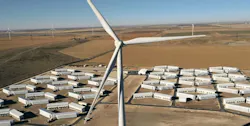
Bitcoin mining and data center developer Soluna Holdings has closed on its $53 million acquisition of a co-located wind farm which will directly power its planned multi-faceted computing campus in west Texas.
Soluna Holdings is acquiring the 150-MW Briscoe Wind Farm through cash and debt financing. The deal marks a milestone for the company in lining up renewable power resources for its portfolio of data and cryptocurrency mining facilities named after famous female engineers.
The Briscoe Wind Farm will support the initial 100-MW Project Dorothy in multiple phases to mine Bitcoin and artificial intelligence training. Ultimately, Soluna has plans to triple Project Dorothy’s computing capacity.
“This closing is a transformative step in Soluna’s evolution,” said John Belizaire, CEO of Soluna, in a statement. “Energy sovereignty is the key durable moat in the AI infrastructure race. By owning the Briscoe Wind Farm, we have secured the cornerstone infrastructure needed to build an AI campus with up to 300 MW of capacity.”
True to Soluna’s history of naming projects after leading female computer scientists, Project Dorothy is in honor of Dorothy Vaughn, an African American woman who led teams in NASA and the National Advisory Committee for Aeronautics. She was played by Octavia Spencer in the 2016 film “Hidden Figures.”
The Briscoe acquisition now vertically integrates Project Dorothy development with Soluna owning the power, land and computing. For the Bitcoin mining unit, Soluna has contracted with cryptocurrency miner Canaan Inc. on a strategic hosting agreement which would deploy about 20 MW of Bitcoin mining technology alongside Soluna’s Project Dorothy in Briscoe County. The Avalon A15 XP mining technology and miners would be deployed this year, according to the announcement.
The 150-MW Briscoe Wind Farm uses 81 GE Vernova turbines and is being interconnected into the Electric Reliability Council of Texas grid system. Briscoe was originally developed by Juwi and later owned by Capital Dynamics.
Earlier this year, Soluna Holdings announced it will partner with energy technology giant Siemens on developing behind-the-meter and control systems to deal with rapid, graphics processing unit (GPU)-driven swings in power demand when running artificial intelligence computing.
The companies signed a memorandum of understanding on teaming up for a 2-MW pilot project at Soluna’s Project Grace in Texas. That site also is located near wind energy and is named after Grace Hopper, a code-breaking computer scientist, U.S. Navy rear admiral and pioneer in the theory of programming language.
The collaboration will integrate Siemens’ electrical infrastructure, controls and monitoring technology to document performance during fast load steps and variable demand scenarios.
Private equity energy funder Generate Capital is a key investor in Soluna Holdings. Soluna overall is developing a 4.3-GW pipeline of projects across the U.S., according to reports.
Next-Gen Digital Infrastructure Needs Diverse Energy Playbook
New and Free E-Book from EnergyTech
Follow ET on LinkedIn
About the Author
EnergyTech Staff
Rod Walton is head of content for EnergyTech.com. He has spent 17 years covering the energy industry as a newspaper and trade journalist.
Walton formerly was energy writer and business editor at the Tulsa World. Later, he spent six years covering the electricity power sector for Pennwell and Clarion Events. He joined Endeavor and EnergyTech in November 2021.
He can be reached at [email protected].
EnergyTech is focused on the mission critical and large-scale energy users and their sustainability and resiliency goals. These include the commercial and industrial sectors, as well as the military, universities, data centers and microgrids.
Many large-scale energy users such as Fortune 500 companies, and mission-critical users such as military bases, universities, healthcare facilities, public safety and data centers, shifting their energy priorities to reach net-zero carbon goals within the coming decades. These include plans for renewable energy power purchase agreements, but also on-site resiliency projects such as microgrids, combined heat and power, rooftop solar, energy storage, digitalization and building efficiency upgrades.