Data Center-Focused GW Ranch Project Clears Texas Air Permitting Hurdle
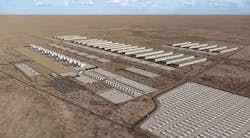
The approval of Texas environmental regulators has boosted prospects for the planned 7.65-GW off-grid gas-fired power generation project to fuel anticipated future data center load in Pecos County, Texas.
Developer Pacifico Energy announced it has received air permitting approval for the GW Ranch project from the Texas Commission on Environmental Quality. The TCEQ permit for 7.65 GW of gas-fired capacity is one of the largest ever granted in the U.S., according to the company.
“We’re really excited to reach this precedent-setting milestone at GW Ranch,” said Nate Franklin, CEO of Pacifico Energy Group, in a statement. “As Texas solidifies its role as a leading market for data center expansion, this 7.65 GW TCEQ air permit underscores our ability to deliver the scale, speed, and regulatory certainty that hyperscale and other large-load customers require.”
The 8,000+-acre GW Ranch site, presumably named for “gigawatt,” is being designed to pair natural gas-fired turbine generation with vast amounts of battery storage capacity. All of that will be focused on directly meeting hyperscale data centers and artificial intelligence (AI) load that would be located in the general area.
Pacifico Energy expects to eventually build out gigawatts of off-grid and gas-fired energy capacity, starting with 1 GW in the beginning to meet developing demand. Focusing on off-grid projects can help speed timelines to avoid long utility interconnection delays.
Pecos County is located in western Texas above the subterranean oil and gas play known as the Permian Basin. The Permian, which stretches into eastern New Mexico, is the biggest oil production play in the U.S., while also boasting daily marketed natural gas production of an average 114 billion cubic feet per day, according to federal Energy Information Administration statistics.
Designed to utilize a private grid that will combine natural gas turbines, solar and battery storage, GW Ranch could enable rapid artificial intelligence and digital infrastructure growth without impacting the electricity grid or increasing energy costs for Texans, according to Pacifico. Many off-grid projects can later be interconnected into the Electric Reliability Council of Texas system, if so desired.
“GW Ranch isn’t just about scale—it’s about certainty,” said Constantyn Gieskes, vice president at Pacifico Energy, said when the project was announced last August. “Every aspect of the project has been designed to solve problems with the status quo in data center development. By building off-grid and working hand-in-hand with local officials, we’re delivering the speed, reliability, and responsible development that our customers and communities both demand.”
Pacifico Energy hopes to complete the GW Ranch power plant and be operational by the first half of 2027. Reaching 5 GW is the company's goal by 2031, which will include dispatchable generators, 1.8 GW of battery storage and 750-MW of solar.
The American Society of Civil Engineers last year graded the U.S. energy infrastructure at a nearly failing D+ in its quadrennial Infrastructure Report Card. Many data center and AI industry leaders are worried that utility-scale power generation and transmission capacity are not currently equipped to meet near-future AI, data center, industrial automation and electrification directions in the commercial and industrial sectors.
These concerns are driving a movement toward off-grid and direct-current technologies. Large businesses which publicly have made off-grid energy connections include Costco, Vantage Data Centers, ENI and the U.S. military.
A Grid in Peril: Resiliency Lives at the Edge
The New Paradigm Driving Microgrid Adoption
Latest E-Book from Microgrid Knowledge
About the Author
 Rod Walton, EnergyTech Managing Editor
Rod Walton, EnergyTech Managing Editor
Managing Editor
For EnergyTech editorial inquiries, please contact Managing Editor Rod Walton at [email protected].
Rod Walton has spent 17 years covering the energy industry as a newspaper and trade journalist. He formerly was energy writer and business editor at the Tulsa World. Later, he spent six years covering the electricity power sector for Pennwell and Clarion Events. He joined Endeavor and EnergyTech in November 2021.
Walton earned his Bachelors degree in journalism from the University of Oklahoma. His career stops include the Moore American, Bartlesville Examiner-Enterprise, Wagoner Tribune and Tulsa World.
EnergyTech is focused on the mission critical and large-scale energy users and their sustainability and resiliency goals. These include the commercial and industrial sectors, as well as the military, universities, data centers and microgrids. The C&I sectors together account for close to 30 percent of greenhouse gas emissions in the U.S.
He was named Managing Editor for Microgrid Knowledge and EnergyTech starting July 1, 2023
Many large-scale energy users such as Fortune 500 companies, and mission-critical users such as military bases, universities, healthcare facilities, public safety and data centers, shifting their energy priorities to reach net-zero carbon goals within the coming decades. These include plans for renewable energy power purchase agreements, but also on-site resiliency projects such as microgrids, combined heat and power, rooftop solar, energy storage, digitalization and building efficiency upgrades.