Unlocking Renewable Revenue Streams: Rooftop Solar for Commercial Real Estate
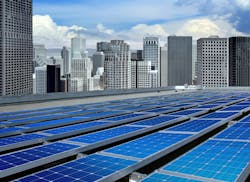
Commercial property owners looking for ways to maximize their value proposition beyond square-foot real estate leases can find asset diversification in rooftop solar, according to a new report by on-site renewables developer Solect Energy.
The article, “Rooftop Solar Site Leases: A New Revenue Stream for Commercial Property Owners,” focuses on the potential for long-term revenue utilizing on-site solar for business real estate. Under solar site leases, the developer leases the rooftop finances and installs solar energy while managing operations and maintenance.
Property owners retain control of their buildings while receiving predictable lease payments. Rooftop solar developers recoup their investment either in long-term power purchase agreements or revenue from deploying their on-site renewables into grid services.
“Rooftop solar site leases function much like a long-term tenant occupying otherwise unused space,” said Matt Shortsleeve, SVP of Policy & Marketing at Solect Energy, in a statement. “For many property owners, it represents a practical way to generate stable income without capital investment or additional operational complexity.”
Properties best suited for rooftop solar site leases often include industrial and warehouse properties, flex and distribution facilities, and large retail buildings with significant usable roof area and long-term site control.
Among commercial sector firms which have signed onto rooftop solar for their facilities includes self-storage provider Public Storage in Minnesota and Signature Center in California. Numerous retail establishments such as Wendy’s and Chik Fil A also have welcomed solar and storage microgrids to some of their restaurants.
The commercial real estate sector covers close to 97 billion cubic feet in the U.S. alone, according to reports. Deploying rooftop solar and battery storage on-site would add potential GWs to the distributed energy resource mix nationwide.
SolMicrogrid is a developer which installed those solar-plus-storage power projects at the restaurants. CEO Kirk Edelman said one size does not fit all when it comes to installing solar at commercial real estate, but ample rooftop capacity makes for a compelling value proposition.
"We are looking at sites which can host a lot of solar capacity at the lowest cost, so rooftop arrays are typically the best option,” Edelman pointed out. “Large grocery store chains are a great use case as they consume a lot of power, and they typically have large roofs. That’s a great combination for us, so we see a lot of potential out there.”
The project must fit the customer’s needs and real estate footprint, Edelman pointed out.
“It has to be a very flexible model that is capable of providing a number of attributes to a site,” he added. “Some hosts want resiliency, but some don’t. If it’s in northern California chances are resiliency is important. In southern California it may not be something the host requests.”
A New Era of Energy Efficiency: Innovations for Today and Tomorrow
New EnergyTech White Paper by Ameresco
About the Author
EnergyTech Staff
Rod Walton is head of content for EnergyTech.com. He has spent 17 years covering the energy industry as a newspaper and trade journalist.
Walton formerly was energy writer and business editor at the Tulsa World. Later, he spent six years covering the electricity power sector for Pennwell and Clarion Events. He joined Endeavor and EnergyTech in November 2021.
He can be reached at [email protected].
EnergyTech is focused on the mission critical and large-scale energy users and their sustainability and resiliency goals. These include the commercial and industrial sectors, as well as the military, universities, data centers and microgrids.
Many large-scale energy users such as Fortune 500 companies, and mission-critical users such as military bases, universities, healthcare facilities, public safety and data centers, shifting their energy priorities to reach net-zero carbon goals within the coming decades. These include plans for renewable energy power purchase agreements, but also on-site resiliency projects such as microgrids, combined heat and power, rooftop solar, energy storage, digitalization and building efficiency upgrades.