Georgia Power Sees Connected Value in Non-Utility Distributed Energy
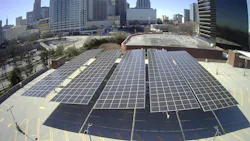
In another sign that distributed energy resources are stepping up in value for utilities and grid operators, Georgia Power has secured its largest distributed generation (DG) procurement in company history.
Regulator Georgia Public Service Commission has given its regulatory approval for Georgia Power’s 16 new DG contracts totaling 70 MW of third-party solar. These new contracts follow 41 MW of new DG solar the utility added two years ago.
Overall, the utility is overseeing more than 110 MW of new solar coming online.
"Georgia continues to grow and experience an increased demand for electricity, driven by a strong economy and robust economic development activities. This milestone underscores how distributed generation solar is helping us deliver clean and reliable energy for our customers through effective long-term planning with the Georgia PSC," said Rick Anderson, senior vice president and senior production officer for Georgia Power, in a statement. "By working with solar developers across the state, we're expanding access to cost-effective renewable resources while strengthening Georgia's energy infrastructure, maintaining reliability and keeping energy affordable for millions of Georgians."
Over the next two years, Georgia Power will seek an additional 100+ MW of solar distributed generation in an effort to expand Georgia Power's solar portfolio. Approved in the 2025 Integrated Resource Plan, two additional distributed generation RFPs with a target of 50 MW each will be released for bid in 2026 and 2027. These projects are expected to be online and generate energy by 2028.
Utilities and energy customers are looking more and more for an “all of the above” approach to new generation, whether it’s natural gas, nuclear or renewables. “Behind-the-meter” projects are offer a specific customer energy resiliency, but also up their value proposition by delivering grid services.
Distributed generation offers more power at the edge of the grid and offsets bottlenecks in utility-scale projects.
Follow ET on LinkedIn
In a recent EnergyTech QuickChat with Managing Editor Rod Walton, DG developer PowerSecure’s Todd Jackson pointed out that distributed energy resources (DERs) are shifting from backup, intermittent assets to essential, grid-integrated tools for power resiliency and supply. PowerSecure, like Georgia Power, are both owned by Southern Co.
“I think the utilities have it right with the DER programs…which helps the with rapid deployment of distributed energy,” said Jackson, who is vice president of corporate development at PowerSecure.
Distributed generation owners and customers are “playing their role in making sure that the grid is as robust as possible, and the utilities and grid operators are accepting of that,” Jackson added. “It's becoming a pretty good marriage of the two working together to solve those ever-evolving grid needs.”
Next-Gen Digital Infrastructure Needs Diverse Energy Playbook
Learn more in New and Free E-Book from Energy
About the Author
EnergyTech Staff
Rod Walton is head of content for EnergyTech.com. He has spent 17 years covering the energy industry as a newspaper and trade journalist.
Walton formerly was energy writer and business editor at the Tulsa World. Later, he spent six years covering the electricity power sector for Pennwell and Clarion Events. He joined Endeavor and EnergyTech in November 2021.
He can be reached at [email protected].
EnergyTech is focused on the mission critical and large-scale energy users and their sustainability and resiliency goals. These include the commercial and industrial sectors, as well as the military, universities, data centers and microgrids.
Many large-scale energy users such as Fortune 500 companies, and mission-critical users such as military bases, universities, healthcare facilities, public safety and data centers, shifting their energy priorities to reach net-zero carbon goals within the coming decades. These include plans for renewable energy power purchase agreements, but also on-site resiliency projects such as microgrids, combined heat and power, rooftop solar, energy storage, digitalization and building efficiency upgrades.