States and Utilities Opting for Greater DER Adoption to Harden Grid, Support Affordability
Electricity demand is growing rapidly due to the rise in manufacturing and data center infrastructure throughout the U.S. The aging U.S. power grid is leading many states and power generators to take action and seek off-grid solutions to boost their distributed energy resources.
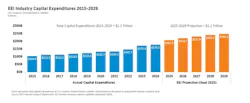
To address future grid reliability, U.S. utilities have proposed investing $1.4 trillion through 2030 on DER projects, according to a PowerLines report. If carried through, it would be a 21% increase from $1.1 trillion over the five-year period outlined in 2025, as these investments focus on addressing physical upgrades to assets such as transmission lines, power plants, distribution poles and wires.
These investor-owned utility companies include Duke Energy, which is investing nearly $103 billion in upgrades to meet data center expansion in Ohio, Florida, Kentucky, Indiana and the Carolinas. Georgia-based utility parent Southern Co. has committed $81.2 billion for upgrades in Alabama and Georgia, while NextEra Energy has committed more than $65 billion in utility-related upgrades in Florida and Texas.
The concern that PowerLines founder and Executive Director Charles Hua pointed out was that these significant capital expenditures over a short period often lead to indications of future utility rate increase requests.
“Our century-old utility regulatory system has accelerated the size of the pie of utility capital spending, even when more cost-effective solutions that could lower consumers’ utility bills are available yet underdeployed,” Hua stated in the report. “It is incumbent upon state policymakers and regulators to ensure utilities prioritize these solutions that improve the efficiency, affordability, and reliability of the grid.”
This is where state legislative action has come into play to introduce more distributed energy resources (DERs) to help balance out and promote consumer affordability ahead of these increased commercialized efforts. These DERs include things such as solar rooftops, managed electric vehicle charging, smart appliances, and battery storage systems like solar generators.
States stepping up to meet the challenge
A new report by the Pew Research Center outlines that DERs are energy generation and storage technologies connected to lower-voltage distribution grids, which reduce strain on the main power grid and improve overall energy reliability. They are typically installed where electricity is needed and allow customers to lower their electricity bills, such as through virtual power plants, demand response, and frequency regulation.
Pew researchers and the North Carolina Clean Energy Technology Center have developed a State Policy Explorer that highlights over 400 DER-related state legislative actions from 2021 to 2025, which have passed measures to advance energy affordability efforts.
Some of these actions are happening in states like Vermont and Illinois that have streamlined interconnection, reducing permitting and certain commercial paperwork, such as a Certificate of Public Good (CPG). These measures would essentially allow consumers the ability to connect to the grid more easily for capacities between 100 kilowatts and 1 megawatt (MW).
Residential electric vehicle charging infrastructure and solar interconnection processes have been both enhanced in Colorado through a streamlined and grant-focused program that helps local governments implement free permitting and inspection software.
States like Tennessee and Idaho, among others, have recognized the need for solutions like microgrids to enhance energy resilience in the face of severe weather events. This would essentially help provide additional reinforcement to critical infrastructure that helps keep communities powered through these circumstances and strengthen security measures.
But these actions still do not limit states' needs for proper planning and setting measurable goals amid the growing rise in energy demand. According to PEW research, fully leveraging existing and future DERs through virtual power plants (VPPs), including providing DER owners appropriate compensation, could deliver power during peak demand at 40%-60% of the traditional cost.
VPPs can aggregate tens, hundreds, or even thousands of DERs into a single, dispatchable resource by using remote cloud-based software. That software manages the output of distributed resources more efficiently on the broader grid, reducing electricity demand at peak times.
Global DER & VPP adoption
In China, which seeks to challenge the U.S. in battery storage and other renewable energy sectors, its State Grid Shanghai Municipal Electric Co. reportedly achieved 1.163 million kWh of load adjustment during peak demand amid record temperatures. Since 2024, State Grid Shanghai has added its VPP enrollment, and capacity has grown 81% across 49 operators.
In Canada, a recently constructed residential community called the Blatchford Lands will fulfill nearly all the annual energy needs for 100 townhomes. Each townhome reportedly has 9 kW to 10 kW of rooftop solar, and during the winter, additional power will be supplied by the power grid when solar production may drop.
The U.S. will need to add new resources like VPPs, energy storage systems, utility-scale renewables, and grid infrastructure upgrades to serve approximately 200 GW of peak energy demand by 2030 as old coal and gas power plants begin to retire, according to the U.S. Department of Energy (DOE). Failure of states to achieve this goal risks overinvesting in traditional grid infrastructure, such as fossil fuel plants, and more likely higher electricity pay rates for consumers.
PEW researchers say that one of the most significant barriers to successfully unlocking the full potential of DERs in the U.S. is the fragmented structure of regulation and electricity policy. Some interconnection authorities require a “first-come, first-served” process, one application at a time, leading to massive backlogs.
Many existing utility rate structures reward traditional grid infrastructure investments rather than integrating more efficient DER measures. In addition to the lack of standardized DER protocols, researchers highlight that this creates financial misalignment with future energy goals.
“DER deployment will be more effective if the utility has a regulator-approved plan that treats DERs commensurately with utility-scale projects,” PEW researchers stated.
PEW adds that state commissions can continue to aid the growth of DERs by reviewing and adjusting existing financial frameworks that surround traditional grid infrastructure. VPP targets in high-risk locations, such as hospitals, data centers, or water utilities, can help remove financial barriers to these adoptions. It can also minimize grid stress, which helps reduce costs for utilities and consumers overall.
From Reactive to Predictive: Turning Energy into Profit
June 4 Webinar on Digital Twins with GridBeyond
About the Author
 Eric Moody