Rotterdam Port Leads in Electrification with ABB's 100-MVA+ Shore Power Installation
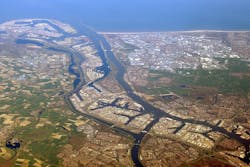
Swiss-based global electrification firm ABB will engineer and construct what may be the world’s largest shore electrification power system at the Port of Rotterdam in the Netherlands.
ABB signed the contract with Rotterdam Shore Power (RSP), a joint venture by the port and Dutch energy company Eneco. The combined shore power systems are expected to be over 100 megavolt-amperes (MVA) in capacity.
The installations will help reduce emissions in the Port of Rotterdam and support compliance with the FuelEU Maritime Regulation, which will require all container and passenger ships above 5,000 gross tonnage to use onshore power supply or equivalent zero-emission technology in EU ports, beginning January 2030.
“We are excited to work together with ABB on this breakthrough project for RSP,” Ina Barge and Tiemo Arkesteijn, Co-CEOs of Rotterdam Shore Power, said in a statement. “Based on deep knowledge and a proven track record, we can help make shore power available to all vessels calling at the APMT and ECT terminals at the Port of Rotterdam, reducing carbon dioxide emissions substantially as a result. Rotterdam is a frontrunner in electrification at this scale.”
Shore power, also known as “cold ironing,” delivers electricity to shoreside electricity to a ship at berth. This helps avoid use of diesel engine generators.
The Port of Rotterdam shore power installations are expected to begin operations in late 2028. They will deliver power across three deep-sea container terminals at the port.
ABB’s shore power systems, providing power at 35 connection points across APM Terminals Maasvlakte II (APMT) facility and Hutchison Ports ECT Delta and Hutchison Ports ECT Euromax terminals, will be able to charge up to 32 container ships at the same time during loading and unloading operations.
The deal also includes a multi-year service agreement for each terminal. While the contracts were booked in December 2025, financial terms were not disclosed.
ABB will also be responsible for commissioning and testing on site. ABB’s scope of supply includes its supervisory control and data acquisition (SCADA) system, which will provide monitoring and control of the shore power system, as well as track energy usage for accurate customer billing.
ABB’s shore connection allows vessels to turn off their engines while at berth.
According to calculations by Rotterdam Shore Power, using shore power for at least 90 percent of fixed time, annual carbon dioxide emissions for the vessels calling at the three deep-sea container terminals are anticipated to be reduced by an estimated 96,000 metric tons from 2030. This will help eliminate noise pollution and improve air quality in the harbor area for a better working and living environment.