South Korean Shipbuilder Launches Ammonia-Powered Vessels to Decarbonize Maritime Transport
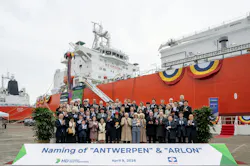
South Korean shipbuilder HD Hyundai Heavy Industries is busy floating the idea that ammonia can be a leading clean energy generation fuel for maritime transport and is putting two such proofs of concept on the deep waters this spring.
HHI has built two ammonia-powered gas carrier vessels ordered by Exmar LGP France. Those ships are scheduled for delivery to the shipowner this May and July following final outfitting.
The two HHI-manufactured 46,000-cubic-meter mid-sized gas carrier vessels, christened Antwerpen and Arlon, were celebrated in a naming ceremony at the company’s Ulsan shipyard in South Korea.
"It is very meaningful for us to have built the world's first ammonia-powered vessel, which requires advanced technical expertise. We will continue to strengthen our leadership in the global eco-friendly ship market through ongoing technological innovation," said Joo Won-ho, head of HHI's Naval & Special Ship Business Unit, in a statement.
They are the first of four ordered by Exmar. HHI altogether has secured orders for a total of eight ammonia-powered vessels from companies including Exmar and Trafigura.
The vessels measure 190 meters in length, 30.4 meters in width and 18.8 meters in height, equipped with three cargo tanks designed and built using HHI's proprietary technology, for the safe transport of liquefied gas cargoes such as ammonia and liquefied petroleum gas (LPG). They also include a shaft generator, which produces electricity using the propulsion engine's rotating shaft, and a selective catalytic reduction (SCR) system to reduce nitrogen oxide emissions.
Ammonia-powered maritime transport was mainly only a concept as early as 2020, but numerous companies are working on vessels utilizing the decarbonizing gas. Some industry researchers are skeptical of ammonia for energy density issues relative to other fuels. Supporters say the gas, known by the chemical symbol NH3, is far less carbon-intensive than some other fuel resources and can be liquified at lower pressure than hydrogen.
A net-zero roadmap released by the International Energy Agency (IEA) has predicted that ammonia will account for 8% of marine fuel demand in 2030, potentially increasing to 46 percent by 2050. HHI has secured orders for a total of eight ammonia-powered vessels from companies including Exmar and Trafigura.
Ammonia can be stored in pressurized tanks at around 8 bar or in refrigerated tanks at -33°C without the need for cryogenic technology. In liquid form, it has about 1.7 times higher storage density than liquefied hydrogen (-253°C) at the same volume, making it ideal for large-scale, long-distance transport and storage of hydrogen.
Next-Gen Digital Infrastructure Needs Diverse Energy Playbook
New and Free E-Book from EnergyTech
Follow ET on LinkedIn