Sail Away Anew: Merchant Vessel Chemical Tankers Set Course with Wind-Assisted Propulsion
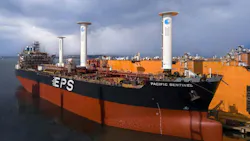
Tacking it back to the beginning: Two industrial merchant vessels are being deployed with new wind-assisted propulsion systems that aim to reduce drag, fuel costs and energy consumption.
The chemical tankers MV Pacific Sentinel and Sunstone are each using several 22-meter suction sails onboard, making them the first deployment of wind-assisted propulsion systems within the Eastern Pacific Shipping merchant vessel fleet. The project is funded through Singapore-based Global Centre for Maritime Decarbonisation and the AIM Horizon Investments-managed Fund for Energy Efficiency Technologies (FEET).
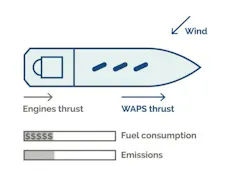
The wind propulsion installation is contracted through a “pay-as-you-save” mechanism much like some microgrid project’s energy-as-a-service model. The Global Centre for Maritime Decarbonization (GCMD) and Eastern Pacific Shipping (EPS) worked together previously on piloting energy efficiency technologies (EET), collecting 276 million data points over four months which indicated an average net fuel savings of about 5.5%, and nearly four times that efficiency under the most favorable wind conditions.
“Scaling EETs depends not just on proving that they work, but on establishing how much fuel they save under real-world operating conditions,” Lynn Loo, CEO of GCMD, said in a statement. “With a methodology now in place to quantify those savings, FEET’s first projects with EPS take the next step: testing how pay-as-you-save financing works in practice, by linking payments to verified fuel savings. This is how we aim to turn operational evidence into investor confidence and unlock wider adoption of EETs across fleets.”
Eastern Pacific Shipping first installed the three bound4blue eSails on the Sentinel in late 2024. The eSails are designed to use the sea’s winds to create multiple times more lift than conventional sails. They reportedly draw air through a vertical surface that creates high-pressure and low-pressure zones on opposite sides, generating additional forward lift to aid the ship’s engine propulsion system.
“Decarbonization moves faster when the technology, the data, and the financing come together,” Eastern Pacific Shipping CEO Cyril Ducau said. “MV Pacific Sentinel has shown what wind- assisted propulsion can do in real operations, and we are pleased to now showcase this first FEET financing designed to assist shipowners wanting to invest in proven solutions. We look forward to seeing more energy efficient technologies make their way onto ships.”
Eastern Pacific Shipping tested the suction sail technology on spot market voyages from the United Kingdom to the Americas last year. AIM Investments’ FEET will use an independent third party to review methodology and long-term results to determine fuel savings for the wind-assisted propulsion system projects it finances. Those savings will be calculated to determine payment structure for customers.
“Launching an innovative fund like FEET required a lot of effort, strong co-operation with GCMD and support by anchor investor Development Bank of Japan and debt providers ING and DBS Bank. The first deployment of FEET’s capital makes all that hard work worth it and delivers the proof of its concept,” AIM Horizon Investments CEO Marcel de Bruijckere said. “We learned a lot from our interaction with the finance and technical teams of EPS and look forward to applying those lessons when making our next investments and scaling up the fund.”
Eastern Pacific Shipping manages vessels owned by other entities. More merchant shipping firms are exploring and testing wind-assisted propulsion on ships in Germany and China, for instance.
Shipping Decarbonization is part of E-Mobility
Check out EnergyTech's Full Coverage
About the Author
 Rod Walton, EnergyTech Managing Editor
Managing Editor
For EnergyTech editorial inquiries, please contact Managing Editor Rod Walton at [email protected].
Rod Walton has spent 17 years covering the energy industry as a newspaper and trade journalist. He formerly was energy writer and business editor at the Tulsa World. Later, he spent six years covering the electricity power sector for Pennwell and Clarion Events. He joined Endeavor and EnergyTech in November 2021.
Walton earned his Bachelors degree in journalism from the University of Oklahoma. His career stops include the Moore American, Bartlesville Examiner-Enterprise, Wagoner Tribune and Tulsa World.
EnergyTech is focused on the mission critical and large-scale energy users and their sustainability and resiliency goals. These include the commercial and industrial sectors, as well as the military, universities, data centers and microgrids. The C&I sectors together account for close to 30 percent of greenhouse gas emissions in the U.S.
He was named Managing Editor for Microgrid Knowledge and EnergyTech starting July 1, 2023
Many large-scale energy users such as Fortune 500 companies, and mission-critical users such as military bases, universities, healthcare facilities, public safety and data centers, shifting their energy priorities to reach net-zero carbon goals within the coming decades. These include plans for renewable energy power purchase agreements, but also on-site resiliency projects such as microgrids, combined heat and power, rooftop solar, energy storage, digitalization and building efficiency upgrades.