Toyota Proving Hydrogen Fuel Cell Promises with Fueling Infrastructure
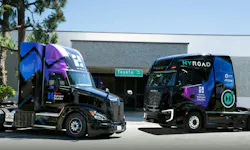
Toyota Motor North America is making a major push for hydrogen fuel cells in the commercial truck market.
The Japanese-based automaker plans to put H2-powered commercial vehicles on the road by next year. Toyota is currently working with Colorado-based National Laboratory of the Rockies (formerly National Renewable Energy Laboratory) to jointly research several hydrogen initiatives including high-flow fueling for heavy-duty trucks.
Achieving flow rates of 300 grams per second could make hydrogen fueling five times faster than conventional light-duty fuel rates, according to Toyota. The fueling is comparable to diesel fueling speed for heavy-duty vehicles, but H2 fuel cells emit only water from the electrochemical process that powers them.
Fueling commercial trucks with energy-dense hydrogen to a range of 450 miles in only eight minutes could be a game changer for decarbonizing the trucking sector.
Toyota recently installed two mobile hydrogen fueling devices at its North American Parts Center California distribution center, which will support its own fleet’s heavy-duty fuel-cell trucks hauling freight from the Port of Los Angeles. Toyota also plans to build a permanent H2 fueling station at the distribution center.
Hydrogen is a light, energy dense gas which does not contain carbon in its molecular chain so does not emit CO2 at the point of ignition. Hydrogen, however, is not naturally mined so it must be produced from carbon-intensive steam reforming of methane gas or by electrolysis splitting the H2 from water.
Earlier enthusiasm for hydrogen e-mobility has waned recently with some automakers such as Stellantis cutting back ambitious rollouts. BMW, Kia and Hyundai, however, are trying to keep pace with Toyota on the H2 fuel cell front and come up with new models later this decade.
About the Author
 Rod Walton, EnergyTech Managing Editor
Managing Editor
For EnergyTech editorial inquiries, please contact Managing Editor Rod Walton at [email protected].
Rod Walton has spent 17 years covering the energy industry as a newspaper and trade journalist. He formerly was energy writer and business editor at the Tulsa World. Later, he spent six years covering the electricity power sector for Pennwell and Clarion Events. He joined Endeavor and EnergyTech in November 2021.
Walton earned his Bachelors degree in journalism from the University of Oklahoma. His career stops include the Moore American, Bartlesville Examiner-Enterprise, Wagoner Tribune and Tulsa World.
EnergyTech is focused on the mission critical and large-scale energy users and their sustainability and resiliency goals. These include the commercial and industrial sectors, as well as the military, universities, data centers and microgrids. The C&I sectors together account for close to 30 percent of greenhouse gas emissions in the U.S.
He was named Managing Editor for Microgrid Knowledge and EnergyTech starting July 1, 2023
Many large-scale energy users such as Fortune 500 companies, and mission-critical users such as military bases, universities, healthcare facilities, public safety and data centers, shifting their energy priorities to reach net-zero carbon goals within the coming decades. These include plans for renewable energy power purchase agreements, but also on-site resiliency projects such as microgrids, combined heat and power, rooftop solar, energy storage, digitalization and building efficiency upgrades.