Cargill's First Green Methanol-Fueled Vessel Sets Course from Philippines
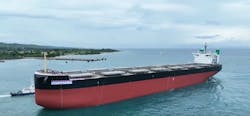
Food and agriculture industry giant Cargill has launched the first vessel in its planned green methanol and dual-fuel dry bulk shipping fleet.
Brave Pioneer has departed from the Philippines on an eventual journey to Europe. The operational trial includes a stop to bunker green methanol in Singapore, proceed to western Australia before setting course for Europe.
Green methanol can be used as a maritime fuel and reduces carbon emissions at point of use compared with conventional fuels. It is produced by combining green hydrogen produced through renewable electrolysis with captured CO2.
“We know the road to low carbon shipping will require a mix of solutions and green methanol is one part of that portfolio,” said Jan Dieleman, President of Cargill’s Ocean Transportation business. “These vessels are engineered to perform at a best-in-class level on conventional fuel today, while allowing us to switch to greener fuels as availability improves. It’s a practical way to future-proof ocean transport.”
The deployment is part of Cargill’s decarbonization effort, which is focused on innovation, testing and learning, as the company works with customers and partners to refine future-ready solutions for itself and the industry. Brave Pioneer, built by Tsuneishi Shipbuilding and owned by Mitsui & Co., is equipped to operate on both conventional marine fuels and green methanol. The estimated CO2 saving of using green methanol as compared to conventional fuel is up to 70%.
Four additional vessels will also join Cargill’s fleet over the coming years, which will strengthen the company’s multi-solution decarbonization approach, including wind-assisted propulsion, voyage optimization technologies, energy-efficiency retrofits and exploration of alternative fuels such as biofuels and ethanol.
Ammonia, another lower carbon energy resource which is combined in the hydrogen process, is also used to decarbonize maritime energy emissions. Earlier this month, German-based energy giant Uniper announced a deal with green ammonia producer AM Green to offtake close to 500,000 metric tons later this decade from a project under construction in India.
E-Mobility is Accelerating. . . By Air and By Land
Free E-Book from EnergyTech.com