Viking Libra's Hydrogen Hybrid System Marks a New Era in Marine Decarbonization
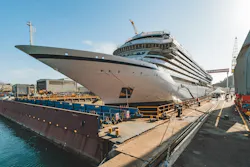
A hydrogen-powered cruise ship has reached a key construction milestone, offering a glimpse into how alternative fuels could scale in large marine applications.
Viking announced that its new vessel, the Viking Libra, has been floated out at the Fincantieri Ancona Shipyard—the first time the ship has entered the water and a signal it is moving into final construction.
The ship, currently under construction in Ancona, Italy, is scheduled for delivery in late 2026, with an inaugural season planned in the Mediterranean and Northern Europe.
For commercial and industrial energy stakeholders, the project highlights the growing role of hydrogen in hard-to-decarbonize sectors. The Viking Libra is designed with a hybrid propulsion system that relies in part on liquefied hydrogen and fuel cells, enabling zero-emissions operation. The system is expected to generate up to six megawatts of power.
Technology development is being led by Isotta Fraschini Motori, a subsidiary of Fincantieri specializing in advanced fuel cell systems. The company is providing a polymer electrolyte membrane (PEM) fuel cell system optimized for cruise operations.
According to the companies, the vessel will incorporate first-of-a-kind solutions to load and store hydrogen directly onboard using a containerized system, an approach intended to address supply chain and fueling infrastructure constraints that have limited broader hydrogen adoption.
The float-out process itself marks the transition from hull construction to final outfitting. After water was introduced into the building dock, the vessel was set afloat over a two-day period and will now be moved to an outfitting dock for interior build-out and final system installation.
Classified as a small ship, the Viking Libra has a gross tonnage of approximately 54,300 tons and capacity for 998 guests across 499 staterooms. A second hydrogen-powered vessel, the Viking Astrea, is also under construction and is scheduled for delivery in 2027.