When Steel Mills Run Out of Time: Infrastructure Lessons from Australia
Key Highlights
- The upgrade involved installing VD4-AF vacuum circuit breakers rated at 2,500A and 22kV, capable of handling 150,000 operations without refurbishment.
- The new equipment reduces greenhouse gas emissions by eliminating SF6, enhances safety, and extends operational life to 10-20 years.
- This project exemplifies how infrastructure upgrades can support increased productivity, flexibility, and environmental sustainability in continuous steelmaking operations.
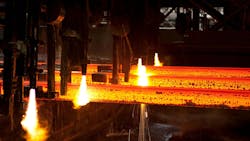
The global steel industry stands at a crossroads.
As facilities worldwide shift toward electric arc furnaces, a technology capable of reducing emissions by up to 86% compared to traditional methods, many are discovering that their electrical infrastructure wasn't built for the journey ahead.
At InfraBuild's Laverton facility in Victoria, this realization came in the form of a decades-old circuit breaker that had simply run out of road. It doesn't happen overnight. First, a replacement part takes weeks instead of days. Then a minor fault requires a workaround instead of a proper fix.
Small issues take longer to resolve. The maintenance team starts mentally preparing for the call that will eventually come: a failure they can't quickly repair.
Additionally, electric arc furnaces can accelerate equipment wear. Within milliseconds, current swings wildly as electrodes pierce through scrap metal.
Each switching operation stresses equipment designed to handle it, but even robust systems have limits. After tens of thousands of operations over decades, Laverton's circuit breaker had reached those limits. The facility's electrical project engineer noted that the situation had become critical — even spare parts could no longer be sourced if equipment showed signs of approaching failure.
Technical requirements and trade-offs
That criticality didn't emerge suddenly. InfraBuild’s electrical team had begun planning the replacement years before failure became imminent, tracking equipment age, accumulated operations, and current rating limitations.
The planning reflected a long-term philosophy. When the arc furnace was originally installed at 71.5 MVA, subsequent upgrades were deliberately oversized, progressively working toward the facility's 100 MVA capacity. The circuit breaker upgrade continued this approach — building headroom for future needs — though it added upfront cost.
After evaluating options from multiple manufacturers, the team selected VD4-AF vacuum circuit breakers integrated into a UniGear ZS3.2 medium-voltage panel. The new equipment is rated at 2,500 amperes (increased from 2,000 amperes) and 22,000 volts, with a short circuit rating up to 100 MVA. Engineered specifically for arc furnace applications, the VD4-AF can handle 150,000 operations without refurbishment (five times more than standard equipment), dramatically reducing maintenance requirements whilst improving reliability.
The existing building layout also drove a critical design decision, as standard panel configurations would have required major structural modifications, which would add cost and extend the project timeline. Instead, the team specified dual cable entry (top and bottom), allowing the equipment to fit within the available space.
Vacuum technology offered additional advantages: unlike the aging equipment, VD4 breakers eliminate SF6 greenhouse gas from the facility whilst incorporating enhanced protection systems and safer operating m echanisms.
Execution under pressure
The installation presented significant logistical challenges. To position the 1.9-tonne panel in the switchgear room at four-story level, the team had to crane it through the roof of the facility. The work proceeded during the December 2021 Meltshop shutdown, with almost five days dedicated to painstaking connection work. The new electrical equipment was successfully commissioned in January 2022 when operations resumed.
The upgrade delivers benefits that extend beyond simple replacement. The new system provides enhanced productivity and more reliable electrical delivery to the arc furnace, whilst dramatically reducing maintenance requirements. The equipment is designed for an operational life of 10-20 years, eliminating the parts availability concerns that plagued the previous installation.
The higher current rating also provides operational headroom that could translate to tangible productivity gains. At Laverton's melt shop, which operates 24 hours a day, six days a week, each furnace cycle takes approximately 40 minutes. The increased power capacity creates the potential to reduce cycle times, directly improving throughput without additional capital investment in furnace capacity.
Why this matters beyond Laverton
The InfraBuild project demonstrates that even in continuous-operation environments, strategic infrastructure upgrades are achievable with proper planning and execution. As the global steel sector navigates its energy transition, with technologies ranging from gas-based direct reduced iron to green hydrogen pathways, having electrical infrastructure capable of supporting diverse future scenarios becomes increasingly valuable.
In Australia, initiatives like the ARC Research Hub for Smart Process Design and Control signal national commitment to advancing low-emission steelmaking technologies. The enhanced capacity and monitoring capabilities built into this upgrade provide Laverton with the flexibility to adapt as production technologies evolve.
For facilities managers in continuous operations, the lesson is clear: plan thoroughly, partner strategically, and execute during scheduled windows. Obsolescence doesn't announce itself with advance warning. The facilities that are future-proofed treat infrastructure modernization as ongoing strategic planning rather than emergency response.
About the Author
Andrew Stepien, ABB
Andrew Stepien is Senior Vice President, Asia Region, ABB Electrification Service.