Sustainable Cocoa Initiative: Mars and ofi Partner to Reduce Climate Impact in Ecuadorian Farming
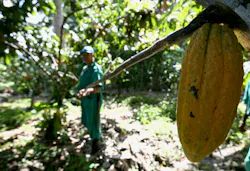
Snack food giant Mars Inc. and ingredients firm ofi are partnering on a five-year program to improve climate impacts from cocoa production in Ecuador.
The new collaboration extends into 2029 and involves 960 cocoa farmers in the regions of El Oro, Esmeraldas, Guayas, Los Ríos, Manabí and Santo Domingo. Mars and ofi will aid those farmers in new practices of regenerative agriculture, from full-sun monoculture to multistrata agro forestry.
They also will utilize low-carbon fertilizers, enhanced crop residue management and biochar applications. The two companies hope that this energy transition strategy will improve soil health, reduce greenhouse gas emissions and increase both carbon dioxide removal and cocoa crop yields over time.
Mars and ofi, the latter of which stands for Olam Food Ingredients, have teamed up on joint sustainable cocoa advancements for more than 15 years. This latest partnership combines the companies’ shared 2050 Net Zero vision to decarbonize farming operations.
“Our latest climate action collaboration with Mars is sparked by our shared, science‑based net‑zero ambitions to create change for a stronger food system so we can continue to enjoy the chocolate products we all love,” Andrew Brooks, head of cocoa sustainability at ofi, said in a statement. “Working jointly in Ecuador for 10 years, we’re developing local insights to help accelerate positive impact for the people and landscapes vital for cocoa.”
Other food technology companies such as Cargill also are attempting to decarbonize cocoa production.
Multistrata agro forestry combines agriculture with forestry, including crops and trees layered within the same farming footprint. Biochar is charcoal created from plant waste and implanted back to enrich soil and remove CO2 from the atmosphere.
Mars is one of the world’s biggest makers of candy bars, snack foods and now pet nutrition products. ofi supplies food ingredients sourced from about 2.8 million farmers worldwide.
“Building on our long-standing collaboration in cocoa sourcing, this effort demonstrates our belief that when companies share common goals, they can deepen cooperation and drive more meaningful impact at scale,” Benjamin Guilbert, global vice president of cocoa at Mars, said. “We value ofi’s ongoing commitment to helping Mars realize our vision of a more modern, inclusive, and sustainable cocoa ecosystem that can support farmers and the environment.”
The companies say that these on-farm investments will positively impact another 4,800 people in surrounding cocoa-growing communities.
Mars previously committed to investing more than $1 billion in its “Cocoa for Generations” sustainability strategy which was focused on 10 years through 2028.
Overall, global cocoa production is around 5.3 million metric tons per year. At that rate, the cocoa industry alone generates close to $40 billion in annual revenue.
About the Author
EnergyTech Staff
Rod Walton is head of content for EnergyTech.com. He has spent 17 years covering the energy industry as a newspaper and trade journalist.
Walton formerly was energy writer and business editor at the Tulsa World. Later, he spent six years covering the electricity power sector for Pennwell and Clarion Events. He joined Endeavor and EnergyTech in November 2021.
He can be reached at [email protected].
EnergyTech is focused on the mission critical and large-scale energy users and their sustainability and resiliency goals. These include the commercial and industrial sectors, as well as the military, universities, data centers and microgrids.
Many large-scale energy users such as Fortune 500 companies, and mission-critical users such as military bases, universities, healthcare facilities, public safety and data centers, shifting their energy priorities to reach net-zero carbon goals within the coming decades. These include plans for renewable energy power purchase agreements, but also on-site resiliency projects such as microgrids, combined heat and power, rooftop solar, energy storage, digitalization and building efficiency upgrades.