Arc of Success: Electrification Advances in the Manufacturing Sector

Electrification advancing through manufacturing is having a big year in 2026, and the technology is expanding as sectors such as steel, glass and metals recycling increasingly adopting electric furnaces for production to both decarbonize and reduce fuel consumption.
From a financial perspective, the electric furnace market will likely surpass $2.1 billion this year headed to a $3+ billion valuation by 2033, according to Cognitive Market Research, Fortune Business Insights and other industrial analysts.
Decarbonizing flat glass production
In late August, global building materials firm Saint-Gobain announced it is working with flat glass manufacturer AGC Group to develop and deploy an electrified hybrid furnace to be used at a Spanish production plant in late 2027.
Construction on the FurHy project will begin in January and will be installed at Saint-Gobain’s flat glass plant in Avilés, Spain. Both companies tout FurHy as the largest electric furnace ever built for flat glass production, capable of achieving 75% electrification in the melting process.
EnergyTech covers the World of C&I Energy Transition
Follow us on LinkedIn
By creating electricity used by the furnace with low-carbon renewable resources procured through power purchase agreements, Saint-Gobain hopes to avoid 80 kilotons of carbon dioxide equivalent emissions per year compared with previous operations.
“Our technological partnership with AGC now reaches a new milestone with the deployment of the world’s first large-scale hybrid electric furnace for flat glass production,” Saint-Gobain Chief Technology Officer Nicolas Miègeville said in a statement.
“This project marks a major step in the decarbonization of flat glass manufacturing, supporting Saint-Gobain’s commitment to net-zero carbon emission by 2050,” he added. “The European Innovation Fund was instrumental in making this project a reality.”
By utilizing electric furnace technology instead of gas-fired power, the company aims to also save on about 265 GWh of natural gas generation per year, which could total about 80% reduction in fossil fuel consumption for that site.
Metal urgency: Steel industry pursues arc of electrification
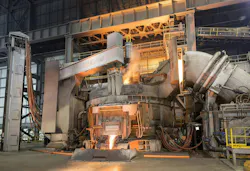
Steel manufacturing also is adopting electric arc furnace technologies in bids for decarbonization and energy efficiency gains. Earlier this year, Nucor began commissioning the melt shop centered around an electric arc furnace at the steelmaker’s new $4 billion mill in West Virginia.
SMS Group supplied the melt shop equipment including two 190-ton, direct-current electric arc furnaces.
U.S. Steel also announced plans for a $1.9 billion direct reduced iron facility in Arkansas. The Big River Steel Works site will have four electric arc furnaces.
“Sustainability also remains central to Big River Steel Works’ identity and a differentiator for our customers,” Dan Brown, executive vice president of advanced technology steelmaking at U.S. Steel, wrote in a December 2025 company blog about the project. “As the first steel mill in North America to earn ResponsibleSteel™ certification, Big River Steel continues to set the pace for lower-emissions, high-performance steelmaking.”
Outside the U.S., Voestalpine this week detailed its new construction on two electric arc furnaces at its Donawitz production site in Austria. South Korea steelmaker Posco is developing electric furnaces reportedly capable of handling 2.5 million metric tons of metal annually at its Gwangyang plant.
Manufacturing and construction account for more than 14% of worldwide greenhouse gas emissions, while electricity and heat account for one-third of all manmade air pollution, according to the World Resources Institute.
State of Market Report: Power Quality Fluctuations
New White Paper by Ubicquia
About the Author
 Rod Walton, EnergyTech Managing Editor
Rod Walton, EnergyTech Managing Editor
Managing Editor
For EnergyTech editorial inquiries, please contact Managing Editor Rod Walton at [email protected].
Rod Walton has spent 17 years covering the energy industry as a newspaper and trade journalist. He formerly was energy writer and business editor at the Tulsa World. Later, he spent six years covering the electricity power sector for Pennwell and Clarion Events. He joined Endeavor and EnergyTech in November 2021.
Walton earned his Bachelors degree in journalism from the University of Oklahoma. His career stops include the Moore American, Bartlesville Examiner-Enterprise, Wagoner Tribune and Tulsa World.
EnergyTech is focused on the mission critical and large-scale energy users and their sustainability and resiliency goals. These include the commercial and industrial sectors, as well as the military, universities, data centers and microgrids. The C&I sectors together account for close to 30 percent of greenhouse gas emissions in the U.S.
He was named Managing Editor for Microgrid Knowledge and EnergyTech starting July 1, 2023
Many large-scale energy users such as Fortune 500 companies, and mission-critical users such as military bases, universities, healthcare facilities, public safety and data centers, shifting their energy priorities to reach net-zero carbon goals within the coming decades. These include plans for renewable energy power purchase agreements, but also on-site resiliency projects such as microgrids, combined heat and power, rooftop solar, energy storage, digitalization and building efficiency upgrades.