HVAC Incentive Estimate vs. Approval: What Building Owners Need to Know
Key Highlights
- Document the existing equipment’s age, efficiency and operating condition before it is removed.
- Use utility bills and account details to identify actual energy use, rates and the applicable program.
- Specify the replacement equipment, capacity, efficiency, displaced system and incentive pathway.
- State the baseline and operating assumptions behind projected savings, including fuel-switching conditions.
- Treat incentives as conditional estimates until written approval confirms the amount, requirements and deadline.

An HVAC incentive estimate is a forecast of what a utility program will pay for a replacement project. A program approval is a written commitment from the utility to pay a specific amount for a specific scope, on conditions. Capital plans that treat the first as the second are where most incentive disappointments start: the equipment is bought, the old plant is removed, and the number that was penciled in turns out to be half what the program will pay, or nothing at all.
That gap often comes down to missing documentation, misunderstood program
requirements or assumptions that have not been confirmed. In the utility efficiency programs that fund commercial and multifamily HVAC replacement, the incentive is calculated from the building's own records, and the rules about when the application is filed are as binding as the rates. The five items below are what an owner, facility director or asset manager should have before an incentive figure is written into a capital line. New Jersey's programs supply the worked examples, because their rules are published in full, but the structure is the same in most states that run utility-administered efficiency programs.
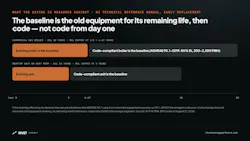
1. A record of the equipment being replaced, including proof that it runs. The single largest variable in an incentive calculation is the baseline: what the new equipment is compared against. For an early replacement of equipment that still works, New Jersey's Technical Reference Manual, the Board of Public Utilities' rulebook for calculating program savings, sets the baseline as the existing equipment for its remaining useful life, and a code-compliant unit after that. The remaining useful life is capped at one-third of the equipment's effective useful life: 6.67 years on a 20-year commercial boiler, 5 years on a 15-year packaged rooftop unit or heat pump. That rule has two consequences for the packet. First, the existing equipment's nameplate efficiency, age and operating condition set the saving, so the record needs the model and serial number, the rated efficiency where it is still legible, and the install year. Where the efficiency is unknown, the manual substitutes the ASHRAE 90.1 value from when the equipment was new, and where the vintage is unknown it assumes 90.1-2013, which is a higher-efficiency baseline than most 1990s plant and therefore a smaller saving.
Second, the old equipment has to be shown working. For custom projects the manual asks for proof that the existing equipment is functioning, including a video or picture of it in operation. Once a boiler has been removed, that proof cannot be produced, and the project loses the early-replacement credit for the old unit's remaining life. In practice this means the equipment record is assembled before any demolition is scheduled, and the old plant stays in
place until the utility's pre-inspection, where one is required.
2. The utility account records the model will run on. An incentive model needs the building's actual energy use, not a square-footage rule of thumb. The packet should hold the latest electric and gas bills for every meter serving the equipment, the rate schedule, and, for electric accounts, the demand charge component, because a heat pump that cuts annual kilowatt-hours can still raise a winter demand peak.
The account records also settle which program the building is in. Multifamily buildings in New Jersey take part through the non-residential account that bills the central plant and common areas, under the utility's commercial programs, not the residential rebates that the first search result usually returns, and the utility that bills the account is the one whose rules apply. Territory boundaries do not follow town lines; the top of the bill is the reliable answer.
3. A replacement scope the program can read. Programs pay by pathway, and the estimate is only as good as the match between the scope and the pathway. Direct Install, which covers most commercial and multifamily buildings in New Jersey (up to 300 kW of demand or 40,000 therms a year), pays a share of the installed cost, up to 80% depending on the building's tier, and takes it off the price at the proposal stage. Custom and engineered measures, for buildings above those limits, pay on modeled savings, typically per kilowatt-hour or per therm saved, with caps. Electrification measures that replace fossil-fuel equipment sit in a third set of programs with their own rates and their own pre-inspection rules.
The scale of the difference is the reason the scope has to be precise. The same tonnage lands in a different pathway depending on the building's demand, whether the gas boiler stays as backup, whether the heat pump carries the cold-climate designation, and whether the scope is written as a replacement or an addition. An estimate that does not state which pathway it assumes is not an estimate; it is a range with the width hidden.
The scope should therefore name the equipment class, the capacity, the efficiency rating that the program keys on, the equipment it displaces, and the pathway the estimate was built in.
4. The assumptions behind the projected savings. The savings figure in an estimate rests on assumptions that the packet should state plainly, because the program will test each one. The baseline is the first. A model that compares the new unit against code, when the program will compare it against the existing equipment for its remaining life and against code only afterward, overstates or understates the saving depending on the plant.
Operating conditions are the second. Buildings do not run at their design conditions. A U.S. Department of Energy Building America study of 18 Northeast multifamily buildings with steam and hot-water heat measured average apartment temperatures of 76.3°F when the buildings' energy management systems were off, against a 70°F design point, and estimated the overheating added about 18.6% to annual space-heating cost. A model built on the design
point misses the saving that controls alone would capture, and a program reviewer who sees a controls measure in the scope will ask what the baseline temperature was.
Fuel switching is the third. New Jersey's manual models a heat pump that is not cold-climate rated as partial displacement, with the fossil system assumed to carry the load below a 35°F switchover, and allows the full-displacement calculation only for cold-climate units. An estimate that assumes 100% of the gas load disappears, for a standard heat pump, will not survive review.
Writing these down is not bureaucratic caution. It is the difference between a number the owner can defend to a lender and one that moves every time someone asks a question.
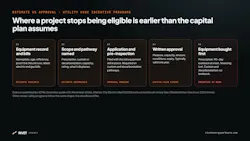
5. The difference between the estimate and the approval. Every utility program sets a point after which the project is no longer eligible, and the point
is earlier than most owners expect. In New Jersey:
- On Direct Install there is no retroactive route at all: the utility's no-cost assessment has to happen before any equipment is ordered, because the incentive is fixed in the proposal that follows it, and the installation is done by a contractor approved under the program.
- JCP&L states that all its programs require pre-approval before purchasing and installing, and that projects are subject to pre-inspection. Atlantic City Electric requires custom measures to be pre-approved before equipment is installed and bought after approval.
- South Jersey Gas and Elizabethtown Gas require pre-approval and an incentive commitment before equipment is purchased, with the approval valid for one year.
- Custom incentives at Atlantic City Electric, New Jersey Natural Gas, South Jersey Gas and Elizabethtown Gas are capped at the lesser of 75% of project cost or a buy-down to a two-year payback.
- On the decarbonization pathway, the fossil-fuel system has to be present at the preinspection, and there is no lookback at all.
An approval is the document that converts the estimate into a capital-plan figure. It states the measure, the capacity, the incentive amount, the conditions and the deadline. Until it exists, the incentive is a forecast and should be carried as one: a conditional amount, with its conditions listed, not a deduction from the project cost.
What the Capital-Plan Line Should Say
A defensible line item for an incentive-funded HVAC replacement carries five things: the project cost, the incentive as approved or as estimated with its pathway and conditions stated, the financing terms, the tax treatment, and the date the approval expires.
On tax treatment, the federal Section 179D deduction for energy-efficient commercial buildings is not available for property whose construction begins after June 30, 2026. A project that began construction before that date can still claim it, even if it is completed in 2027, but an estimate that carries it for a project starting now is carrying a number that no longer exists.
The packet described here takes a few weeks to assemble, most of it waiting on the utility. It is cheap compared with what it protects. The owner who has it can put a number in the capital plan and defend it. The owner who does not has an estimate, and an estimate is a hope with a decimal point.
Editor's note: Program requirements vary by utility and state. The New Jersey examples illustrate common considerations, but building owners should confirm eligibility and application requirements with their local utility.
About the Author
Josh Weingarten
Josh Weingarten leads client work at Rivet Energy, a Lakewood, New Jersey firm that prepares the building surveys, energy models and utility incentive applications for commercial and multifamily HVAC replacements across the state. Installation is performed by licensed partner contractors. rivetenergypartners.com
Related
 Cambridge Ee