Duke Energy Expands Battery Storage at Former Coal Power Plant
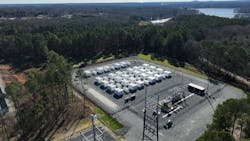
Utility Duke Energy has brought a new 50-MW, four-hour battery energy storage system (BESS) online at its former Allen coal-fired power plant in southern North Carolina.
The $100 million BESS project will be utilized to energize the grid for customers in both South Carolina and North Carolina. Duke Energy also announced plans to build out additional battery storage capacity at the Gaston County site.
Construction of a second BESS – Duke Energy’s largest, a 167‑MW, four-hour system – will begin in May on 10 acres where the coal plant’s now-demolished emissions control system once stood. Both lithium-ion battery systems qualify for federal investment tax credits, which will offset 40% of the cost for Duke Energy customers.
“We are proud of how this site and its people continue to support our customers,” said Bryan Walsh, Duke Energy’s vice president of Regulated Renewables and Lake Services, in a statement. “Multiple former Allen plant employees now work on our Regulated Renewables team, which maintains and operates the new batteries at Allen and elsewhere in the Carolinas. Duke Energy’s test site for new battery technologies, its Emerging Technology and Innovation Center, is also in Mount Holly.”
Utility-scale battery storage is increasingly favored as a tool to provide grid balancing and deliver early morning electricity when solar generation is offline. Batteries can be charged by solar farms or the grid itself during periods of low demand, then discharged when demand is higher.
G.G. Allen Steam Station was a 1.1-GW coal-fired power plant which operated for more than 60 years. The last standing of Allen’s five units was retired in 2024.
Duke Energy plans to make similar battery storage investments in multiple counties across the Carolinas. The company’s 2025 Carolinas Resource Plan, now under review by state regulators, projects the addition of 6,550 MW of batteries by 2035 to protect reliability and meet growth needs in North Carolina and South Carolina.
Balancing Act: U.S. Battery Storage Capacity Races Ahead
Utility-scale battery storage capacity may top 50 GW this year and exceed 60 GW in 2026, according to a federal Energy Information Administration report. Even so, battery storage only represents about 2% of the overall U.S. electricity generation mix.
Despite a return to focus on fossil and nuclear energy by the Trump Administration, the EIA still expects that solar and battery storage additions could top 80% of all added electricity generation this year.
Duke Energy is Host Utility
The Microgrid Knowledge Conference 2026
Happening May 4-6 in Orlando
About the Author
EnergyTech Staff
Rod Walton is head of content for EnergyTech.com. He has spent 17 years covering the energy industry as a newspaper and trade journalist.
Walton formerly was energy writer and business editor at the Tulsa World. Later, he spent six years covering the electricity power sector for Pennwell and Clarion Events. He joined Endeavor and EnergyTech in November 2021.
He can be reached at [email protected].
EnergyTech is focused on the mission critical and large-scale energy users and their sustainability and resiliency goals. These include the commercial and industrial sectors, as well as the military, universities, data centers and microgrids.
Many large-scale energy users such as Fortune 500 companies, and mission-critical users such as military bases, universities, healthcare facilities, public safety and data centers, shifting their energy priorities to reach net-zero carbon goals within the coming decades. These include plans for renewable energy power purchase agreements, but also on-site resiliency projects such as microgrids, combined heat and power, rooftop solar, energy storage, digitalization and building efficiency upgrades.