Large-Scale Fire Testing Requirements of NFPA 855 and Why It Matters for Energy Storage Stakeholders
Key Highlights
- Large-scale fire testing evaluates how a fully representative BESS installation behaves during severe fire events, focusing on system-level fire propagation and safety outcomes.
- The 2026 NFPA 855 standard shifts from theoretical modeling to empirical, full-scale testing, providing regulators, insurers, and communities with more realistic safety assessments.
- Realistic installation configurations, including auxiliary equipment, are critical in fire tests to ensure data applicability for permitting, design, and safety strategies.
- System-level fire data supports better design decisions, reduces permitting uncertainties, and aligns safety practices across manufacturers, regulators, and insurers.
- The emphasis on large-scale fire testing underscores its importance in scaling energy storage safely, building public confidence, and supporting grid decarbonization efforts.
For the first time in decades, electricity demand is expected to outpace historical averages, driven by the proliferation of hyperscale datacenters for artificial intelligence and the rapid electrification of transportation across both commercial and consumer sectors. In response, energy stakeholders are increasingly turning to battery energy storage systems (BESS) to support grid reliability and flexibility. Modern BESS can be deployed modularly in nearly any environment and do not require onsite grid upgrades, making them especially attractive for seamless integration. These advantages have spurred rapid BESS adoption worldwide, with battery storage capacity increasing by an average of 67% per year over the last decade.
As deployment has expanded, the associated safety risks have become more apparent. Of particular concern is thermal runaway, in which batteries can release stored energy uncontrollably through heat, flammable gases, and fire following physical damage, electrical faults, or operational failures. A series of high-profile lithium-ion battery storage fires in recent years has intensified regulatory scrutiny and underscored the limits of traditional, small-scale fire testing.
Most notably, fires at the Moss Landing energy storage facility in California exposed how quickly localized battery failures can escalate at the system level, prompting evacuations and raising concerns among regulators, insurers, and communities. These incidents demonstrated that component-level fire tests alone cannot fully predict real-world fire behavior in large, densely packed installations.
In response, NFPA 855, Standard for the Installation of Stationary Energy Storage Systems, has emerged as the central safety framework governing BESS installations across North America. While not itself a code, NFPA 855 underpins adoption by the International Fire Code and numerous state and local jurisdictions. Its 2026 edition represents a significant shift in how energy storage safety is evaluated and approved.
Why NFPA 855 Now Includes Large-Scale Fire Testing Requirements
The 2026 edition of NFPA 855 elevates large-scale fire testing from a supporting reference to a central performance-based requirement. This shift reflects growing recognition among regulators that laboratory scale tests, while valuable, are insufficient to assess thermal runaway propagation, gas generation, and fire dynamics in modern BESS installations.
Under the updated framework, large-scale fire testing is used to validate hazard mitigation strategies, support performance-based alternatives to prescriptive requirements, and provide defensible data for Authority Having Jurisdiction (AHJ) decision making. Rather than relying primarily on theoretical modeling or design intent, NFPA 855 now emphasizes empirical evidence derived from full scale system testing. The updated NFPA 855 (2026 edition) integrates hard-won lessons from real-world incidents, now requiring comprehensive, installation-level fire propagation tests, in addition to component-level testing, at the cell, module, and system level tests.
This approach aligns with broader trends in critical infrastructure regulation. As battery energy storage becomes integral to grid stability and decarbonization efforts, safety expectations increasingly mirror those applied to other essential infrastructure systems. Large-scale fire testing provides regulators, insurers, and communities with greater confidence that worst case failure scenarios have been realistically evaluated and addressed.
Large-Scale Fire Testing Under NFPA 855
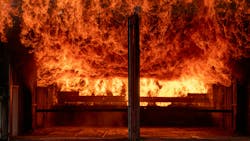
Large-scale fire testing is intended to evaluate how a fully representative BESS installation behaves during a severe fire event. The focus is not on confirming that individual components meet certification requirements, but on understanding whether a fire originating in one unit can propagate to adjacent systems under realistic conditions.
NFPA 855 emphasizes outcomes rather than procedural minutiae. Testing is designed to demonstrate that adjacent units do not experience ignition, thermal runaway, or unacceptable temperature exposure during a fully developed fire. By prioritizing system level behavior, the standard allows regulators to assess whether proposed designs achieve safety outcomes equivalent to or exceeding prescriptive requirements.
Why Large-Scale Fire Testing Matters Across the Industry
Large-scale fire testing functions as common evidence for a diverse set of stakeholders. For manufacturers, it requires that safety claims be supported by full scale empirical data rather than cell, module, and or unit level certifications alone. This raises the bar for validation while also providing clearer pathways for regulatory approval.
For system designers and integrators, large-scale fire test data informs decisions related to enclosure layout, separation distances, ventilation strategies, and thermal mitigation features. Access to system level performance data reduces uncertainty during permitting and construction and helps align designs with regulator expectations early in the project lifecycle.
For regulators and AHJs, large-scale fire testing provides a defensible basis for evaluating performance-based designs. Rather than extrapolating from reduced scale tests or theoretical models, decision makers can rely on observed system behavior under controlled but realistic fire conditions.
For insurers, full scale test data helps reduce ambiguity around loss scenarios and risk exposure. As underwriting scrutiny of energy storage projects increases, credible system level fire data is becoming a prerequisite for long term insurability.
Observations from the Test Floor
Over the last number of years, CSA Group has been working closely with AHJs and insurance companies to provide and quantify comprehensive test data. From this fruitful collaboration, several best practice methods have been established.
Experience conducting large-scale fire testing has reinforced the importance of installation realism. One of the most consistent lessons is that the initiating BESS unit must closely reflect an actual field installation, including auxiliary equipment such as power conversion systems, HVAC components, cabling, and control hardware.
Including these elements has proven critical for regulatory and insurance review, as test results are increasingly used to support performance-based approvals, spacing reductions, and mitigation strategies. When installations are simplified or idealized, test data often becomes difficult to apply in permitting discussions, leading AHJs or insurers to require additional analysis or impose more conservative conditions.
By contrast, full scale tests that reflect real world configurations tend to produce results that are more readily accepted, helping to reduce uncertainty and align fire protection engineering models with observed system behavior. In practice, this realism can influence decisions much earlier in the project lifecycle, shaping enclosure design, spacing assumptions, and mitigation strategies before they reach regulators or insurers.
The 2026 edition of NFPA 855 marks a turning point in energy storage safety. By making large-scale fire testing a foundational requirement, the standard acknowledges that system level fire behavior cannot be reliably inferred from component level testing alone.
For an industry scaling at unprecedented speed, large-scale fire testing provides a data driven foundation for safer deployment, more consistent regulatory approval, and increased public confidence. As battery energy storage becomes central to modern grid infrastructure, demonstrating safety through credible full-scale testing is no longer optional. It is essential.
About the Author
Omri Tayyara
Omri Tayyara, Ph.D. is the Global Technical Business Manager – Energy Storage/ Energy & Power at CSA Group.