Polaris Power to Develop 71.4 MW Battery System Co-Located with Wind Farm in Puerto Rico
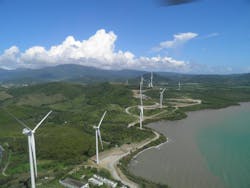
The governing grid authority for the outage-prone island of Puerto Rico has approved a new utility-scale battery energy storage system (BESS) project that will be co-located with a wind farm.
The board of the Puerto Rico Electric Power Authority (PREPA) has approved an agreement with Polaris Power US, a subsidiary of Canadian-based Polaris Renewable Energy, to deliver the battery storage for increasing grid reliability within the U.S. territory. It is part of the Puerto Rico Accelerated Storage Addition Program aimed at pairing BESS installations with existing generation facilities.
"The PREPA Governing Board's authorization of the SO1 Agreement marks an important step forward in the development of our battery energy storage initiatives in Puerto Rico,” said Marc Murnaghan, CEO of Polaris, in a statement. “This project further reinforces our commitment to enhancing grid reliability on the island while building on the strategic value of our existing Punta Lima asset."
Under this framework, Polaris Power US will act as the resource provider responsible for the installation and operation of the BESS, while Punta Lima Wind Farm, another subsidiary of Polaris, will continue to serve as the generation facility owner for the Punta Lima site where the storage system will be located.
Once the BESS project is constructed and fully operational, the resource provider will be entitled to receive monthly fixed and performance-based payments from PREPA in exchange for providing energy storage services, including capacity and grid support. The project has a BESS capacity of 71.4 MW (35.7 MW x 2).
The commercial operation date is expected to begin 12 months after execution of the final agreement, running for a 20-year term from the commercial operation date.
While PREPA is working to shore up utility grid resiliency on an island prone to hurricanes and transmission system outages, the territory also is embracing distributed energy resources despite a reduction in U.S. federal funding for decarbonizing energy projects. In some cases, private companies and nonprofits have stepped in to bolster the microgrid and DER infrastructure in Puerto Rico.
To help provide resilience while government funding is being slowed or eliminated, a private nonprofit organization, Bravo Family Foundation, has awarded Cooperativa Hidroeléctrica de la Montaña, an electric cooperative, $2.2 million to install 10 microgrids in the island’s central mountain region. The Department of Energy also provided $3.5 million from the State and Tribal Resilience Formula Grants Program.
Together, the 10 microgrid systems will provide 875 kW of solar generation and 1.85 MWh of energy storage. Each community microgrid will consist of three to five essential service businesses, including medical clinics, pharmacies, supermarkets and bakeries, ensuring essential services will continue during outages.
Taming Digital Transformation to Improve Energy Management
Next Week's Free Webinar with Siemens Digital Industries
Live on Tuesday and On Demand Afterward
About the Author
EnergyTech Staff
Rod Walton is head of content for EnergyTech.com. He has spent 17 years covering the energy industry as a newspaper and trade journalist.
Walton formerly was energy writer and business editor at the Tulsa World. Later, he spent six years covering the electricity power sector for Pennwell and Clarion Events. He joined Endeavor and EnergyTech in November 2021.
He can be reached at [email protected].
EnergyTech is focused on the mission critical and large-scale energy users and their sustainability and resiliency goals. These include the commercial and industrial sectors, as well as the military, universities, data centers and microgrids.
Many large-scale energy users such as Fortune 500 companies, and mission-critical users such as military bases, universities, healthcare facilities, public safety and data centers, shifting their energy priorities to reach net-zero carbon goals within the coming decades. These include plans for renewable energy power purchase agreements, but also on-site resiliency projects such as microgrids, combined heat and power, rooftop solar, energy storage, digitalization and building efficiency upgrades.