Capacity*Connect: Xcel Aims to Boost Reliability with Distributed Energy Storage
As electricity demand rises and grid infrastructure ages, utilities are increasingly constrained not by how much power they can generate, but by how quickly and reliably they can deliver it.
Xcel Energy’s proposed Capacity*Connect program is designed to address that challenge by adding distributed battery storage to its Minnesota grid, rather than relying solely on new central power plants.
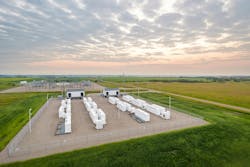
The program aims to integrate up to 200 battery energy storage systems into Xcel’s Minnesota grid by the end of 2028. Each front-of-the-meter battery system, ranging from 1 MW to 3 MW, would be strategically located to serve customers during periods of peak demand.
The stored energy would be used to offset peak load, meet bulk system capacity needs or participate in Midcontinent Independent System Operator (MISO) energy markets.
“By storing energy when it’s cheap, delivering it when it’s needed most and placing assets where they maximize grid value, Xcel Energy is delivering reliable energy to customers today and building a grid that is ready for tomorrow,” Pier LaFarge, CEO of Sparkfund, said in a statement.
Sparkfund, which enables utilities to plan and deploy DERs at scale to support load growth and unlock grid value, will work with Xcel on the Capacity*Connect program.
The utility filed its Capacity*Connect proposal with the Minnesota Public Utilities Commission in October. The filing also includes the limited deployment of a grid Distributed Energy Resources Management System (DERMS), which would inform a future utility-wide DERMS deployment.
The DERMS would enable Xcel to monitor, coordinate and dispatch growing numbers of distributed assets—like solar and batteries— across the distribution grid in real time, allowing the utility to maintain system reliability and optimize local grid performance.
Xcel says batteries are key to Minnesota’s energy future
Xcel’s proposal comes as Minnesota utilities work to comply with the state’s clean energy requirements. A 2023 state law mandated that electric utilities provide 100% carbon-free energy by 2040, with 55% of all retail electricity sold coming from renewable sources by 2035.
Investor-owned utilities, including Xcel, must reach 80% carbon-free electricity by 2030.
Xcel says Capacity*Connect would aid in integrating more renewables into the grid and mitigate any renewable energy curtailment. Curtailment, or the intentional reduction in output, typically happens when supply exceeds demand or there isn’t enough transmission capacity to move energy from where it’s generated to where it’s needed.
Energy storage prevents that capacity from being wasted.
Under the Capacity*Connect plan, battery systems would be installed at local businesses, commercial and industrial sites, or local nonprofits.
If approved by the Minnesota PUC, Xcel would begin site selection and deploy 3 MW to 5 MW of battery storage to support the bulk energy system in 2025 and 2026. The company expects the program to expand to between 50 MW and 200 MW by 2028.
“We’re focused on supporting economic growth and the needs of our communities by building out and modernizing our energy grid,” Ryan Long, president of Xcel Energy-Minnesota, North Dakota and South Dakota, said in a statement when the proposal was announced in October. “We believe distributed energy resources are an important part of that strategy. They will complement our current plans for additional renewable and firm dispatchable generating resources to meet our customers’ needs.”
The utility’s Upper Midwest Energy Plan calls for 600 MW of energy storage by 2030, in addition to a 300 MW lithium-ion battery at its Sherburn County Generating Plant (Sherco) site in Becker, Minnesota.
The beginning of a new era
Xcel’s Capacity*Connect proposal has drawn attention from industry leaders, including Jigar Shah, co-managing partner of Multiplier and former director of the U.S. Department of Energy’s Loan Programs Office.
“For the first time in my professional career, we have a utility company formally agreeing with the fact that distributed power plants are essential to maintaining reliability and meeting load growth,” Shah said in a recent LinkedIn post.
However, not all stakeholders support the plan. Public comments filed in the proceeding, including those from the Joint Solar Parties (a coalition that includes the Coalition for Community Solar Access, the Minnesota Solar Energy Industries Association and the Solar Energy Industries Association) raise concerns about costs, risks to ratepayers and impacts on competitive solar and energy storage markets.
Shah said many of those concerns “simply don’t hold up.”
“Capacity*Connect is not the finish line: it is the foundation upon which a competitive, flexible, and scalable distributed energy market can be built,” he said. “Further, it enables key investments in the people, processes and tools–like power flow analytics and DERMS–that are essential to unlocking deployment of all types of DERs.”
Shah urged industry leaders to recognize the significance of the proposal, calling it “the beginning of a new era in which distribution-tied storage will be a core pillar of the growth of the grid.”
About the Author
 Kathy Hitchens
Kathy Hitchens
Special Projects Editor
I work as a contributing writer and special projects editor for Microgrid Knowledge and sometimes EnergyTech. I have over 30 years of writing experience, working with a variety of companies in the renewable energy, electric vehicle and utility sector, as well as those in the entertainment, education, and financial industries. I have a BFA in Media Arts from the University of Arizona and a MBA from the University of Denver.