Battery Storage Projects Expand in Central Europe as Demand for Grid Flexibility Grows
Battery energy storage continues to gain momentum in Europe, with several new large-scale projects moving into development in Germany and Austria toward the end of 2025. The projects, announced by energy storage provider ADS-TEC Energy, add a combined 20 megawatts (MW) of capacity and 40 megawatt-hours (MWh) of storage and are now entering detailed planning phases.
The additions reflect broader trends across European power markets, where utilities and large energy users are turning to battery storage to manage renewable generation variability, stabilize grids, and respond to increasingly volatile electricity prices.
Among the recent developments is a battery storage system selected by Stadtwerke Ludwigsburg-Kornwestheim (SWLB), a municipal utility in Germany. The project involves a 5 MWh battery system integrated with an existing biomass power plant. The combined setup is designed to improve grid stability while enabling participation in wholesale energy and ancillary services markets—an approach that highlights how storage is being paired with dispatchable and renewable assets to improve operational flexibility.
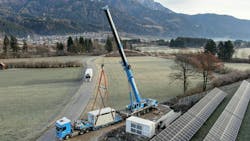
In Austria, a 5 MWh battery storage system was commissioned in December at AAE Naturstrom. The system is connected to a photovoltaic installation and is intended to store locally generated solar power for later use or grid injection, depending on market conditions. Projects like this illustrate how battery storage is increasingly used to shift renewable energy to higher-value periods rather than exporting power immediately when it is generated.
Beyond these mid-scale installations, planning is also underway for significantly larger storage developments in Germany. One project under development includes a grid connection capacity of up to 1 gigawatt (GW) and storage capacity of 2 gigawatt-hours (GWh), with the potential to double to 4 GWh. Grid connection commitments have reportedly been secured, with permitting and planning activities continuing into 2026.
For commercial and industrial energy users, the expansion of large-scale battery storage has implications beyond the utility sector. As more storage assets come online, they can help reduce congestion, moderate peak prices, and improve overall system reliability—factors that directly influence energy costs and power quality for large facilities. In markets with growing renewable penetration, battery systems are increasingly viewed as a critical component of modern energy infrastructure rather than a niche technology.