Oilfield Services Giant Boosts Supply Chain Connection with Energy Storage Startup
Historic oilfield services firm Baker Hughes is deepening its integration within long duration energy storage projects through a new agreement with Hydrostor.
Baker Hughes, which has been an investor in Hydrostor since 2019, will supply up to 1.4 GW worth of equipment as part of Hydrostor’s core design offering for its advanced compressed air energy storage (A-CAES) solution. Baker Hughes highlighted its commitment by making the announcement at the company’s annual meeting in Florence, Italy.
“Increasing pressure on electric grids is making long-duration energy storage an urgent priority. Hydrostor's innovative approach offers a low-carbon solution to ensure power reliability across a diverse mix of generation resources,” Baker Hughes CEO and chairman Lorenzo Simonelli said in a statement. “We are proud to support Hydrostor with critical technology to accelerate these projects, supporting greater global grid resilience, and enabling sustainable power systems at scale.”
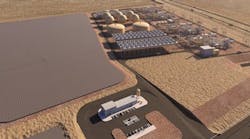
Hydrostor is progressing on flagship energy storage projects in the U.S. and Australia. These include the Willow Rock Energy Storage Center project in Kern County, California, and Broken Hill in Australia.
“The agreement Hydrostor has signed with Baker Hughes underscores the momentum behind our A-CAES technology platform that is able to cost-effectively provide reliability and resiliency to grids around the world,” said Curtis VanWalleghem, HydroStor co-founder and CEO. “We’re excited to build on our relationship with Baker Hughes as we near construction for our flagship projects and work to expand our project pipeline, as load grows and AI data center infrastructure is being built out globally.”
Hydrostor will complete construction on its projects in the U.S. and Australia soon. In the initial phase of the agreement, Hydrostor will be deploying up to 1.4 GW of power generation and compression technology solutions from Baker Hughes’ portfolio including compression, expander, motor and generator technology.
The company’s technology utilizes excess power available on the grid, running that through turbines to convert the energy into compressed air. That compressed air is then pumped into large underground caverns and stored for future energy when the grid is stressed by higher demand.
In addition to Baker Hughes, other primary investors in Hydrostor include Goldman Sachs Asset Management. CPP Investments, Canoe Financial and Canada Growth Fund, among others.
Willow Rock Energy Storage Center is near the start of construction this year after gaining final permitting approval from the California Energy Commission. The 500 MW / 4,000 MWh advanced compressed air energy storage (A-CAES) project is designed to store energy for eight hours of continuous discharge to the grid and promises to provide reliability and resiliency amidst rapidly rising electricity demand.
Baker Hughes is one of the world’s largest oilfield services firms and started 118 years ago as the Hughes Tool Co. Then purely a drill-bit manufacturer, Hughes Tool was run by founder Howard Hughes Sr. and his son until the latter CEO shifted his interests into the film industry, aviation and other endeavors.
Baker International and Hughes Tool Co. merged in 1987.
About the Author
EnergyTech Staff
Rod Walton is head of content for EnergyTech.com. He has spent 17 years covering the energy industry as a newspaper and trade journalist.
Walton formerly was energy writer and business editor at the Tulsa World. Later, he spent six years covering the electricity power sector for Pennwell and Clarion Events. He joined Endeavor and EnergyTech in November 2021.
He can be reached at [email protected].
EnergyTech is focused on the mission critical and large-scale energy users and their sustainability and resiliency goals. These include the commercial and industrial sectors, as well as the military, universities, data centers and microgrids.
Many large-scale energy users such as Fortune 500 companies, and mission-critical users such as military bases, universities, healthcare facilities, public safety and data centers, shifting their energy priorities to reach net-zero carbon goals within the coming decades. These include plans for renewable energy power purchase agreements, but also on-site resiliency projects such as microgrids, combined heat and power, rooftop solar, energy storage, digitalization and building efficiency upgrades.