B2U Connects 28-MWh Second-Life Battery Storage Project Online to Support Texas Grid
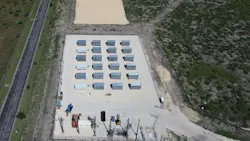
B2U Storage Solutions has officially begun commercial operation for its 28-MWh Bexar Martinez recycled battery project in Converse, Texas.
Located just northeast of San Antonio, the project marks B2U’s second operational site in Texas, following its 24-MWh Bexar Corrilla project, which went live in 2025. The Bexar Martinez site is designed to deliver critical grid services into the Electric Reliability Council of Texas (ERCOT) market.
Built entirely from repurposed electric vehicle (EV) batteries, the project aims to demonstrate the viability of second-life storage at utility scale. B2U’s work highlights the efforts of extending battery usefulness beyond their time in vehicles to reduce waste and grid storage costs.
"Reaching 50 MWh in Texas is an important milestone, but the bigger story is what it represents,” said B2U Storage Solutions CEO Freeman Hall in a statement. “Every battery we redeploy keeps valuable resources in service longer, strengthens the grid, and shows the market that repurposed EV batteries are ready to compete today."
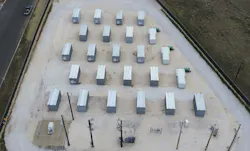
The two Texas sites help bring the company’s overall operating capacity to roughly 100 MWh (10 MW) across Texas and California, where B2U is headquartered. B2U currently manages more than 5,000 repurposed EV batteries across both solar-paired and stand-alone systems.
This expansion follows a June partnership with autonomous driving tech company Waymo to scale a sustainable second-life pipeline for thousands of EV batteries. Waymo agreed to create a supply of recyclable retired batteries from its fleet of EVs to install them into B2U’s BESS configurations that support electric grid infrastructure from California to Texas.
Although EV batteries eventually are no longer useful powering EVs, which take higher energy density to move after degrading from automotive use, developers are increasingly repurposing them for energy storage systems.
According to the Institute of Electrical and Electronics Engineers (IEEE), retired EV batteries still maintain 70% to 80% of their original charge life. IEEE highlights that this remaining power can be reliably deployed as a second-life energy storage solution to bolster grid stability.
Companies like Element Energy and Allye Energy, for instance, also are focused on repurposing EV batteries to create a more circular energy storage economy. In 2024, Allye enabled the reuse of repurposed EV batteries from U.K. recycling company SYNETIQ to make up a grid-connected energy storage system. Meanwhile, in the U.S., Element Energy advanced a 53-MWh project in west central Texas that same year, which successfully repurposed 900 EV batteries.
About the Author
 Eric Moody