TVA's Browns Ferry Nuclear Plant Secures 80-Year Operating License Extension
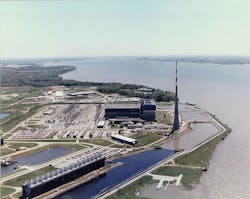
Tennessee Valley Authority’s first-ever nuclear power plant will keep rolling and reacting at least 30 more years after the U.S. Nuclear Regulatory Commission renewed operating licenses for the nearly 4 GW of capacity in Alabama.
The NRC approved extensions which will allow all three units at TVA’s Browns Ferry Nuclear Plant to generate carbon-free power until the 2050s. TVA’s application stressed that population growth in the region was one of the compelling motivators for the license extensions.
Read EnergyTech's Full Coverage of Next-Gen Nuclear
Browns Ferry’s three units can generate close to 3.8 GW at capacity. The plant’s overall capacity factor, or how often it runs at or near capacity, achieved close to 90% in recent years.
“This is a strong example of how independent oversight and effective collaboration can deliver results that support our energy future,” said Jeremy Groom, Acting Director of the NRC’s Office of Nuclear Reactor Regulation, in a statement. “The NRC confirmed that Browns Ferry’s reactors can safely operate for up to 80 years, and TVA’s responsiveness helped us complete our rigorous review nearly three months ahead of schedule.”
Browns Ferry is located near Athens in Limestone County, Alabama. Its three units were commissioned in 1974, 1975 and 1977, and they are GE boiling water reactors cooled by water from Wheeler Lake.
Recent data released by the U.S. Energy Information Administration indicates that Browns Ferry produced close to 2.4 million MWh of electricity in June 2025. For the previous six years, the nuclear reactors generated close to 30 million MWh annually.
"The subsequent license renewal at Browns Ferry marks a proud and historic moment for TVA and the communities we serve," said TVA's President & CEO Don Moul. "This is more than a regulatory milestone - it affirms TVA's continued commitment to nuclear power and the future of American families, jobs and energy independence."
Browns Ferry is the latest of legacy U.S. nuclear power plants to gain re-licensing up to 80-year life spans. The nation’s 90-plus utility-scale units generate close to 18% of the total U.S. electricity portfolio–or about half of the carbon-free power generation–and several are being re-licensed or even revived to meet anticipated future data center and industrial electrification demand.
A long-term power purchase agreement between digital tech firm Microsoft and power generator Constellation will finance a restart of the former Three Mile Island Unit 1, now called the Crane Energy Center, in Pennsylvania. Constellation is partnering with Meta on keeping the Clinton nuclear plant open in Illinois and also is working to restart the Duane Arnold Nuclear facility in Iowa with financial support from Google.
About the Author
EnergyTech Staff
Rod Walton is head of content for EnergyTech.com. He has spent 17 years covering the energy industry as a newspaper and trade journalist.
Walton formerly was energy writer and business editor at the Tulsa World. Later, he spent six years covering the electricity power sector for Pennwell and Clarion Events. He joined Endeavor and EnergyTech in November 2021.
He can be reached at [email protected].
EnergyTech is focused on the mission critical and large-scale energy users and their sustainability and resiliency goals. These include the commercial and industrial sectors, as well as the military, universities, data centers and microgrids.
Many large-scale energy users such as Fortune 500 companies, and mission-critical users such as military bases, universities, healthcare facilities, public safety and data centers, shifting their energy priorities to reach net-zero carbon goals within the coming decades. These include plans for renewable energy power purchase agreements, but also on-site resiliency projects such as microgrids, combined heat and power, rooftop solar, energy storage, digitalization and building efficiency upgrades.