CERAWeek Consensus: Natural Gas Rules the Next-Gen Bridge to Future Infrastructure Growth
Ten years ago, the energy world was buckled down to tight expectations of price stability, flat load growth and a move away from globalism.
It feels like a lifetime ago, right? What once was tight was knocked loose by a roundhouse multitude of unseeable revolutions, topping out with the unstoppable current of artificial intelligence breaking on the economic shoreline.
Mary Landrieu sees it clearly. The longtime Democrat leader may be out of the U.S. Senate, but she still represents the interests of her home state Louisiana and its energy-rich history.
What’s changed in 10 years? Energy—how it’s generated, where it goes and who needs it the most—is at the center of a completely new dynamic. The rise of AI, automation, industrial reshoring and electrification are a joint disruption creating the tidal wave that swept away that “ancient” 2016 dynamic of predictable load growth, renewable energy domination and energy efficiency controls.
The present is moving fast, and the future will move faster. The operative motto today is more, more and yes more, please, and in the most abundant, economical way possible. The energy transition now means more than the sun and the wind; it goes thousands of feet deeper.
“Things have changed: The reality has set in that hydrocarbons are going to a big part of the energy mix for many, many, many decades in the world,” former Sen. Landrieu told EnergyTech during an exclusive interview at the CERAWeek conference in Houston.
All of the above energy with natural gas leading the way

She now heads up the group Natural Allies for a Clean Energy Future, which advocates for using more natural gas as a bridge fuel that offers both baseload and flexible generation in this new era of a so-called Industrial Compute Age.
Landrieu remembers the bygone world of flat load growth, of more predictable demand scenarios, and of coal, gas and nuclear power plant retirements in the rush to interconnect more solar and wind to the grid.
“Well that never really was going to work,” she corrected. “Let’s roll up our sleeves and get to work. Stop leaving anything on the table and let’s do offshore wind, onshore wind, solar, gas, oil and even new technologies like geothermal. Natural gas is probably our quickest and fastest option, and we say that because it’s more plentiful.”
This stance was clearly in vogue with many at CERAWeek, which always has been a global oil and gas conference peppered with experts and enthusiasts on renewables and even nuclear. This week, however, the consensus was “all of the above” more than ever.
Natural gas-fired generation likely must lead the way because it can be built cheaper and faster than nuclear power but also offers dispatchable-scale electricity that renewables and battery storage cannot match for now.
Todd Brezler, senior vice president for digital transformation at power generation equipment manufacturer Mitsubishi Power, noted that his company has seen an uptick in corporate and utility orders for aeroderivative gas turbines, a logical choice in behind-the-meter and off-grid power project development. In fact, Mitsubishi Power's aeroderivative inventory is sold out as part of this rush to site or co-locate islanded power near data centers and AI factories.
“It’s very much power now,” Brezler told EnergyTech. “It’s a challenge to keep up.”
The U.S. exploration and production sector is nearly three decades into its natural gas shale drilling revolution and now has elevated itself and the nation as the world’s top exporter of liquified natural gas. In the same period, the natural gas portion of U.S. utility-scale electricity generation has doubled to now more than 40%.
Meanwhile, data center load growth is expected to expand by maybe 125 GW in the coming decade. Considering the U.S. utility grid is currently lagging in the infrastructural ability to deal with this growth, data-AI hyperscalers and other industrial customers are considering on-site and co-located power generation most easily served by natural gas and co-located renewables. Advanced nuclear can join in later.
“You’ve got to have reliability, and you’ve got to have dispatchable power,” Mitsubishi Power’s Brezler pointed out. “Without those it’s hard to power AI. . . So there’s a lot of interest in gas turbines for the next decade, and it looks like the right solution.”
Sen. Landrieu hails from a state—Louisiana—with deep roots in oil and gas, including LNG infrastructure. Brezler works for a global original equipment manufacturer with a storied history in gas turbine development.
Both are certainly influenced by those facts, but they are only part of a consensus that baseload natural gas, next-gen nuclear and renewables paired with battery storage must grow the power generation pie in the coming decades.
The age of abundance is upon us with respect to energy demand. We have no choice but to meet the moment head-on.
“If you don’t have reliability, you’re not going to have economic growth,” Brezler said.
The "holistic" path to embracing baseload generation
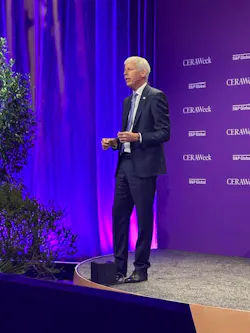
CERAWeek is attended by energy experts from all over the world, and often their national political leaders in the sector. From European energy ministers to U.S. Secretary of Energy Chris Wright and some of his predecessors, the path forward is becoming more obvious.
Baseload, flexible and plentiful.
“The simple math is that we need way more energy,” Secretary Wright said during a Next-Gen Amphitheater session mainly with energy students at CERAWeek.
“They desperately need to see faster generation,” he noted, highlighting the national desire to accommodate hyperscalers and win any global AI race. “And we want energy sources besides hydrocarbons, absolutely. We need solar, nuclear, fusion. . . We need to look at everything holistically. We should be looking at the whole energy system.”
The supply-side mission was a priority on the interconnection side from the 1950s to 1970s, when a large part of the existing nuclear generation fleet was first commissioned. Since, coal plants are being retired and almost certainly won’t return to their previous prominence, while GWs of nuclear power were also shut down for economic reasons.
Natural gas is king--at least in the U.S.-- for today and tomorrow whether it’s universally desired or acknowledged or not. Digital necessity is the mother of modern invention, and gas-fired generation is the bridge fuel selected to deliver the biggest wave of energy required for AI factories and supercomputing capacity.
And those hyperscalers such as Google, Meta, Microsoft and Amazon are not only compelled, but increasingly eager to help. They are pushing for faster power generation which can initially be built off-grid and later interconnected.
And they seem willing to pay for it, which is nice because energy affordability is certainly a critical concern in an era of unprecedented demand.
“These guys started getting their heads in the game and said, ‘ok, let’s see about solutions,” former Sen. Landrieu said. “These are some of the smartest people on the planet, and they are taking a little bit more control and responsibility.
“They will bring energy to the table,” she added. “They will help figure out a way with utilities and cooperatives to get more molecules on the grid and potentially lower the price for everyone. The greater the supply, the lower the price.”
And that push for super-abundance opens a lot of doors for a lot of resources. Geothermal investment is rising, while next-gen nuclear investment is rising and renewable PPAs are not going away. Resiliency and sustainability are still the goals of companies seeking to thrive in a commercial and industrial energy transition.
“The global economy is going to need a lot more energy from every source possible,” Amit Chandra, managing director and head of climate technology within the energy transition group at global banking giant Barclay’s, said during a second-day session at CERAWeek.
John Kotek, senior vice president of policy development and public affairs at the advocacy group Nuclear Energy Institute, touted nuclear generation as the future-forward destination bridging both emissions reduction and baseload addition.
“We’ve worked hard to be recognized for the clean energy attributes that nuclear delivers,” Kotek said during the same session with Chandra. “It’s the largest source of carbon-free electricity in the U.S. and many countries.”
Energy Secretary Wright would certainly concur that. He is bullish on next-gen nuclear, leading a DOE initiative to encourage development and achievement in small modular reactor criticality in pilot phase by this July 4, making the nation’s 250th birthday.
“Nuclear got rolling in the 1950s, and then was stifled later,” he said. “It’s easier stopping things than doing things.”
The current nuclear renaissance, as some have called it, is led by deals such as Microsoft’s multi-billion-dollar power purchase deal with Constellation that will finance reopening of the Three Mile Island Unit 1. Industrial firms such as Dow and Big Tech hyperscalers such as Google are also exploring SMR nuclear deals to power their manufacturing and computing operations, respectively.
“Nuclear is not close to competing with natural gas (price-wise) right now,” Secretary Wright added. “But it will be in the long run.”
Wright’s mantra, as such, could be boiled into these words: “Let’s not be the country where we don’t build stuff anymore.” Read White House Report on Building Data Center Infrastructure.
This intransigence has stalled momentum for U.S. bridges, manufacturing and energy infrastructure in recent decades. And now the nation must scramble and forge creative, safe ways to accelerate power generation capacity by every resource that makes sense and can be scaled.
“Our multiple energy resources allow us to continue to be the most advanced economy in the world,” former Sen. Landrieu pointed out. “We need to remain open and moving forward. Let’s not be afraid.”
EnergyTech Covers Many Paths to C&I Energy Security
Follow ET on LinkedIn
About the Author
 Rod Walton, EnergyTech Managing Editor
Rod Walton, EnergyTech Managing Editor
Managing Editor
For EnergyTech editorial inquiries, please contact Managing Editor Rod Walton at [email protected].
Rod Walton has spent 17 years covering the energy industry as a newspaper and trade journalist. He formerly was energy writer and business editor at the Tulsa World. Later, he spent six years covering the electricity power sector for Pennwell and Clarion Events. He joined Endeavor and EnergyTech in November 2021.
Walton earned his Bachelors degree in journalism from the University of Oklahoma. His career stops include the Moore American, Bartlesville Examiner-Enterprise, Wagoner Tribune and Tulsa World.
EnergyTech is focused on the mission critical and large-scale energy users and their sustainability and resiliency goals. These include the commercial and industrial sectors, as well as the military, universities, data centers and microgrids. The C&I sectors together account for close to 30 percent of greenhouse gas emissions in the U.S.
He was named Managing Editor for Microgrid Knowledge and EnergyTech starting July 1, 2023
Many large-scale energy users such as Fortune 500 companies, and mission-critical users such as military bases, universities, healthcare facilities, public safety and data centers, shifting their energy priorities to reach net-zero carbon goals within the coming decades. These include plans for renewable energy power purchase agreements, but also on-site resiliency projects such as microgrids, combined heat and power, rooftop solar, energy storage, digitalization and building efficiency upgrades.