Jordan Approves $1B Green Ammonia Export Hub to Lead New Middle East Market
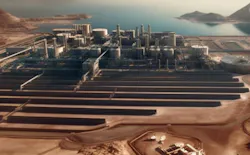
Jordan has announced the approval of a $1 billion investment agreement to develop a utility-scale green ammonia production facility in the country’s shift toward a lower-carbon industrial footprint.
Prime Minister Jaafar Hassan was present for the signing of the agreement between the Ministry of Energy and Mineral Resources and Jordan Green Ammonia Co., a Polish–Emirati consortium between Polish developer Hynfra and UAE-based developer the Fidelity Group. This investment comes as Jordan looks to become a regional green energy exporter by entering the global hydrogen economy.
Jordan Green Ammonia Co. states the project will be designed as an off-grid, vertically integrated facility located near the strategic port of Aqaba. The plan is for the facility to be engineered to operate independently of the national electrical grid and powered by a 550-MW solar array connected with battery energy storage systems (BESS).
The facility is projected to produce 100,000 metric tons of green ammonia annually for export to European and Asian markets. Project members add that it will also help mitigate roughly 200,000 metric tons of carbon emissions per year.
The project’s financial closure is targeted for September 2027, with commercial operations expected to begin in late 2030.
NH3 offers starting point for decarbonization in shipping, storage
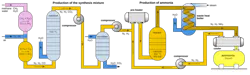
Researchers highlight that ammonia (known by chemical symbol NH3), shows decarbonizing potential the industrial and transportation sectors as an energy carrier for hydrogen and a clean fuel for maritime shipping. NH3 (one part nitrogen, three parts hydrogen in the molecular chain) also is widely used to produce agricultural nitrogen fertilizers.
Due to ammonia containing no carbon and being easier to store or transport than liquid hydrogen, it is increasingly being considered as a temporary vector to overcome standalone hydrogen-related challenges. Another challenge hydrogen presents is that 95% of its production is made by natural gas steam reforming which is carbon intensive.
In a widely used industrial technique called the Haber-Bosch process, nitrogen and hydrogen are directly combined to form ammonia, as the Rocky Mountain Institute (RMI) detailed in a study. Hydrogen is then extracted, which is reportedly easier since NH3 holds more energy in less space. During transport, this requires less extreme temperatures and lower pressures than necessary with standalone hydrogen.
Nitrogen is separated from the air and hydrogen is extracted from water electrolysis, powered by renewable energy, instead of fossil fuels. Once fed into the Haber process, hydrogen and nitrogen react together at high temperatures and pressures to produce NH3, all powered by sustainable electricity.
U.S.-based Ammonia-to-power firm Amogy announced similar moves to expand green ammonia operations. Under its joint venture with South Korea’s GS Engineering & Construction, the two began collaborating in Pohang City, South Korea to create ammonia-based and ammonia-to-hydrogen distributed power generation for industrial customers.
Maritime energy infrastructure firm Hoegh Evi and Wärtsilä Gas Solutions completed development of their floating ammonia-to-hydrogen cracker facility in Norway. The objective was to improve the ability of import terminals to produce hydrogen from transported ammonia at an industrial scale.
And transporting nearly 500,000 tons of green ammonia from an Indian plant under construction was committed by German-based multinational energy firm Uniper. A part of a deal with AM Green, the partnership focuses on future ammonia shipments beginning in 2028. They aim to produce close to one million metric tons of green ammonia per year in Kakinada.
About the Author
 Eric Moody