Predicting the Future of Power: Next-Gen Nuclear, Grid Edge Lead ET Reader Poll Results
Of all the crystal balls in all the trade publications, this one shined brightest on reactors, renewables and batteries to lead the way over the next quarter century of energy evolution.
A few weeks ago, EnergyTech.com asked its readers in a poll to choose the resources which they think might carry the commercial and industrial (C&I) energy transition future. The results are in, and ET’s audience of C&I energy decision makers are apparently big believers in the next generation of nuclear, solar and energy storage.
In fact, given one choice, 39% of ET respondents selected small modular reactor (SMR) nuclear as the resource to play the most significant role in new power generation by 2050.
Diverse energy playbook top of mind led by nuclear
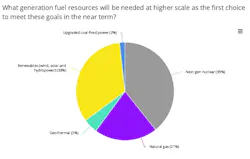
The nuclear enthusiasts outnumber those choosing the more conventional natural gas power by nearly two to one, according to the EnergyTech poll. In fact, renewable energies such as wind, solar and hydropower attracted a close second with 33% of the vote.
In a more broad-based follow-up question, ET readers were asked to pick all the resources most likely relevant to strengthening the grid and grid edge by 2050. Sixty-three percent chose SMR nuclear and 25% chose nuclear fusion, which is making progress in research and experimentation but doesn’t even have a commercial-scale model built yet.
That’s a true sign of faith in the promise of fission and fusion.
“After decades of being a lower priority in the power generation mix due to the twin challenges of economic competitiveness and flat load growth, nuclear energy is now top of mind in most energy conversations around the future bridging resource adequacy and sustainability,” EnergyTech Managing Editor Rod Walton said. “These poll results show our readers are some of those leaders deeply considering the potential of SMRs and next-gen nuclear, while also acknowledging the sustained growth in both renewables and natural gas already on the ground. It looks like we’re going to need nearly everything to meet a future of AI, cloud-based computing, industrial automation and electrification.”
The big picture gets more diverse the closer energy gets to the customer. Indeed, most ET readers responding chose renewables and longer duration battery storage alternatives to lithium ion as playing the most significant roles at the grid edge in coming decades. Seventy-seven percent predicted renewables and storage as the top grid-edge technologies by 2050, followed by SMR nuclear, geothermal (40%), hydrogen (30%), nuclear fusion (25%) and new coal capacity (12%).
The U.S. coal-fired generation sector continues to drop in proportion to the rise of natural gas and renewables, but the Trump Administration has adopted a fossil-fuel-heavy stance which includes new incentives to try and fortify the steam coal fleet. Even so, ET readers don’t seem impressed yet, acknowledging some future role for coal-fired power but only 2% chose it when offered one choice.
Distributed priorities: behind meter, off grid and microgrid
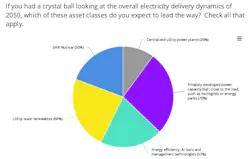
A third question asked EnergyTech readers to take a glance at their proverbial crystal ball one more time and predict which asset classes would lead C&I-level electricity dynamics by 2050. Behind-the-meter, microgrids and data center energy parks carried the vote at a resounding 70%.
Grid interconnection delays and the struggle of utility and transmission system infrastructure to keep up with advances in power load growth were squarely the center of discussion at last week’s Microgrid Knowledge Conference in Orlando. Many believe that AI and other digital infrastructure expansion will tax the grid beyond its capacity and force more grid edge, off-grid and on-site prime power solutions.
“The key point is the frailty of the grid; the grid right now is in dire straits,” e2 Companies founder and CEO James Richmond told Microgrid Knowledge at the event. “When the EIA (U.S. Energy Information Administration) forecasts that outages will go up 100X by 2030 and it doesn’t hardly make the news, people are asleep at the wheel.”
EnergyTech.com readers are obviously awake to the situation. In the EnergyTech poll, 52% of respondents also cited AI as a solution for energy overload, providing energy efficiency and management technologies to mitigate the challenge somewhat.
Among the other top asset classes forecast for 2050, 60% chose utility-scale renewables, while exactly half chose SMR nuclear and centralized utility power finished last at 26%.
Next-gen nuclear may seem to have a clear path—for now—to meet the future of commercial and industrial energy consumption. The reality is more polarizing, as proponents tout the baseload and carbon-free qualities, while opponents point out financial, safety and regulatory roadblocks to small modular reactor growth.
EnergyTech.com focuses on the commercial and industrial customer’s energy transitions, achieving goals for supply, resiliency, sustainability and affordability. EnergyTech and Microgrid Knowledge are both part of Endeavor B2B.
About the Author
EnergyTech Staff
Rod Walton is head of content for EnergyTech.com. He has spent 17 years covering the energy industry as a newspaper and trade journalist.
Walton formerly was energy writer and business editor at the Tulsa World. Later, he spent six years covering the electricity power sector for Pennwell and Clarion Events. He joined Endeavor and EnergyTech in November 2021.
He can be reached at [email protected].
EnergyTech is focused on the mission critical and large-scale energy users and their sustainability and resiliency goals. These include the commercial and industrial sectors, as well as the military, universities, data centers and microgrids.
Many large-scale energy users such as Fortune 500 companies, and mission-critical users such as military bases, universities, healthcare facilities, public safety and data centers, shifting their energy priorities to reach net-zero carbon goals within the coming decades. These include plans for renewable energy power purchase agreements, but also on-site resiliency projects such as microgrids, combined heat and power, rooftop solar, energy storage, digitalization and building efficiency upgrades.