Copper Not Just Playing Hard to Get: Critical Metal for Electrification is Facing Supply Crisis

Copper never goes out of fashion. It has proved essential to humans for thousands of years from infusing early coins to making modern-day electricity transmission possible in the electricity industry.
Copper’s criticality grows ever bigger as artificial intelligence (AI) and data center expansions rely heavily on it for power and cooling infrastructure. A next-gen hyperscale facility can reportedly consume 50,000 tons of the metal.
Roughly 70% of globally mined copper is used to generate, transmit and manage electricity due to its safe and vital electrical and thermal conductivity, according to the International Copper Association (ICA). Copper is also resistant to corrosion.
In the energy transition to net-zero emissions targets, renewables such as solar and wind power require up to 12 times more copper per megawatt (MW) than traditional fossil fuel systems, ICA highlights. For electric vehicles, copper use is two to three times higher than in standard gasoline-powered vehicles.
Without copper, traditional power plants could not function, and the electricity that travels from them to homes and businesses would not be produced.
Have we made the case for how good copper is? OK, now for the bad news: Researchers point out that this surging demand for copper is set to create a major supply deficit. This shortfall is driven by massive buildouts of data centers and the parallel electricity power generation needed to support them.
"Copper is becoming extremely critical across many industrial verticals,” CEO Brendan Smith of tech startup SiTration told EnergyTech. “But at the same time the global supply chain is running up against rapidly decreasing ore grades, longer timelines to bring new mines online and a lack of refining capacity.”
Inadequate copper supply
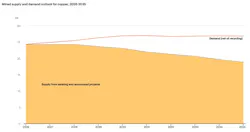
By 2035, the global copper market is on track to face a 30% supply deficit, even as the world enters what some are calling the “Age of Electricity,” according to the International Energy Agency (IEA). The average global grade of copper mines, which measures the average concentration of pure copper found in all the mined rock worldwide, has reportedly decreased by 40% since 1991.
The rapid compounding of this trend is being tied to the declining rate of new resource discoveries of all the copper deposits discovered in the last 35 years. Only 5% have been discovered in the last decade, according to S&P Global, resulting in lead times of 17 years from discovery to production for heavily dependent copper projects.
Altogether, Smith adds that this is leading to a projected $140 billion supply deficit by only 2035.
This inadequate supply and economic shifts in mining dynamics have also contributed to a spike in copper theft nationwide. The U.S. Department of Energy estimates that overall copper metal theft costs American businesses roughly $1 billion annually.
In 2026, authorities tracked three major copper theft events across the U.S. Thieves pulled off a massive $1.3M heist targeting copper wire spools meant for AI data infrastructure—a case labeled the Chicago Data Center Cargo Theft. In Florida, criminals stripped 100,000 feet of wire worth $250,000 from interstate light poles in what officials called the Pensacola Bridge Lighting Theft, leaving major bridges completely dark for months. At the then vacant Tulsa Promenade Mall in Oklahoma, multiple groups of trespassers were reportedly caught on separate occasions scrapping large bundles of copper wires and pipes.
These dynamics are tightening the copper market, making it harder for investment to satisfy the urgent demand for raw materials from new mines for smelting plants that produce this metal.
Among the identified copper that has yet to be extracted from the earth, roughly 65% is reportedly found in just five countries—Chile, Australia, Peru, Mexico and the U.S.
Advancing material efficiency
“Accessing the estimated half trillion dollars of copper trapped in mining waste is essential to mitigating this shortage,” SiTration's CEO Smith told EnergyTech.
Companies like SiTration are working to address this dilemma around copper supply and the need for expanded electrification through recovery, considering copper retains 100% of its electrical conductivity no matter how many times it is recycled.
The Massachusetts tech startup, consisting of scientists and engineers from diverse backgrounds, is deploying silicon property systems onto mining sites. The objective is to recover critical copper minerals from dilute and complex streams without chemicals and intensive processes traditionally associated with mining.
Smith said these systems aim to produce multiple tons of copper per month, utilizing sub-units (electrodes) ready for full-scale commercial build-out.
“What that means is that those systems will be producing square-meter sheets of copper at the market grade, and those copper sheets will be indistinguishable from any other copper produced around the world,” Smith explained.
Smith states that mining waste is a huge part of all mining, including copper mining, which is one of the more water-intensive minerals and metals currently mined worldwide.
“Every kilogram of copper that we're producing, we're actually at the same time producing about 100 liters of wastewater that's typically going into these tailings ponds, tailings dams and waste storage facilities,” he added. “There's really no current way that's efficient to deal with that water. So, there's kind of a two-pronged challenge here.”
One part of this challenge, Smith pointed out, is dealing with that wastewater as it accumulates. Another is retrieving the copper value that's trapped within that waste.
“In terms of copper, what you have globally is an estimated half trillion dollars worth of copper value that's trapped in this mining waste. Unlike other ways that we can amplify the supply chain, we actually know where this copper is located,” he said.
Smith explained that SiTration’s mission is to unlock stranded and trapped copper from that waste in a way that is efficient, sustainable and profitable compared to globally operating copper mines.
Conventional mining consists of digging up virgin ores or virgin rock from the ground to grind up. It’s done either by leaching, which means exposing it to acid to dissolve out the copper, or by smelting, which is burning or melting out the copper and then recovering it downstream.
“Both those process routes are quite complicated and quite resource-intensive. What we're doing is really streamlining the entire process,” said Smith.
Because this copper is already located in a dissolved ionic state (separated and broken apart into invisible, electrically charged pieces) within wastewater, SiTration can access it directly. Their on-site systems utilize a single-step electrochemical process powered entirely by electricity.
“We have a single step, literally one step. So, running this wastewater through our systems, the innovative nature of our systems and materials allows us to pull out that copper directly using only electricity. So essentially trading electrons for high-purity copper,” he said.
Bridging the copper gap
Growing project complexities for expanding existing brownfield projects, which expand active copper smelters and mines, have driven up capital costs by 65% since 2020. IEA data show overall expenditures are approaching levels typically associated with greenfield projects that start completely from scratch.
Starting a new greenfield copper mine can reportedly take nearly 18 years on average globally, and close to 30 years in the U.S. due to heavily regulated permitting.
To meet the global energy transition, Amanda van Dyke of Critical Miners Hub in the U.K. highlighted that it will take a “mining transition” to extract as much copper in the next 25 years as in the past 125 years. SiTration positions its technology as a solution, offering a low-carbon emission process that reduces environmental impacts compared to traditional mining.
“These new hyperscale centers people are talking about building in the U.S. and elsewhere require about 50,000 tons of copper,” Smith noted. “When you relate that to mining, what that means is about the annual output of a relatively large copper mine.”
But SiTration expects global mining supply to fall off quite rapidly as the copper grade—meaning the copper concentration in the rock dug up—drops (by about 50% in the last 35 years alone). They expect that decline to accelerate as miners continue to find and deplete the most copper-rich resources worldwide.
To bridge this gap, the company adds that new copper entering waste deposits accessible today is growing at about $5 billion per year, referring to the copper discarded within these ores. Operating broadly across Utah, Arizona and the U.S. Southwest, SiTration plans to increase the amount of market-grade copper produced domestically wherever mining waste is located.
This will help meet the heavy electrical infrastructure demand needed for AI data center components and solar energy. According to Smith, solar cells, batteries and energy storage systems installed across the U.S. consume about 190,000 tons of copper yearly.
“We can significantly impact the supply chain in a way that is both highly profitable, which is important for these mining partners, but it's also very efficient and very sustainable for the world and for the environment,” Smith added. “So, we need to bring all these things to bear, and it takes innovative technologies to be able to do that.”
About the Author
 Eric Moody