BlackRock and Others Lead U.S. Sustainability Fund Growth Despite Regulatory Uncertainty

Investors have spent the past four years shunning or at least shying away from U.S.-based sustainability-focused index and equity funds due to geopolitical and market pressures. The tide returning to backing decarbonization technologies has turned, if only gradually and perhaps even passively.
Investment inflow to U.S. sustainability funds has gone positive for the first time since 2022, according to bond rating and financial analysis firm Morningstar’s second quarter Global Sustainable Fund Flows report.
Positivity after 14 quarters of sustainability outflows
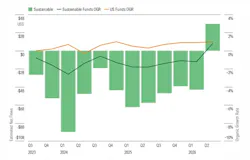
Led by private equity giant BlackRock, investment in U.S. sustainability-focused equity and mutual equity funds attracted nearly $3 billion to the plus side. This is compared to an outflow of $4.3 billion in the first quarter, according to Morningstar.
This $3 billion inflow arrived after 14 consecutive quarters of outflows. Those funds that performed best were led by passive strategies and by simply following indices.
“Active funds continued to see outflows, although redemptions moderated to USD $3.6 billion in the second quarter,” reads the Morningstar quarterly flow report.
The leader in the sustainability fund clubhouse so far this year is called First Trust Nasdaq Clean Edge Smart Grid Infrastructure (known by the ticker symbol GRID on the market). GRID attracted $3.1 billion in the second quarter, indicating strong interest in energy transition infrastructure and technologies supporting rising power demand from AI and data centers, according to Morningstar.
A Fidelity.com snapshot of GRID’s top holdings includes Schneider Electric, Johnson Controls, Eaton, Quanta Services, ABB and E.On. The Fidelity chart indicates the GRID fund has grown slightly less than 100% over the past five years but has nearly sextupled an original $10,000 investment since 2015.
The second most popular sustainability fund for inflows was the Neuberger Quality Equity followed by Big Data focused Invesco MSCI North America Climate ETF (exchanged traded fund). The Invesco fund has grown nearly 22% over one year and includes top holdings such as NVIDIA, Apple, Microsoft, Amazon and Alphabet.
Volatility in global geopolitical and oil markets may be forcing investors to reassess priorities toward energy alternatives. Total asset value of U.S. sustainability funds hit a new record of $398 billion by the end of June, Morningstar reported. BlackRock leads all sustainability fund managers with $76 billion in that class of assets, while Vanguard trails in second place with nearly $51 billion.
“Regulatory uncertainty continued to shape the U.S. sustainable investing landscape during the second quarter of 2026,” reads the Morningstar analysis. “In May, the SEC’s (Securities Exchange Commission) proposed rescinding its 2024 climate-related disclosure rule; if finalized, this would remove the climate-specific reporting framework before it takes effect and leave companies subject to existing principles-based disclosure requirements.”
About the Author
EnergyTech Staff
Rod Walton is head of content for EnergyTech.com. He has spent 17 years covering the energy industry as a newspaper and trade journalist.
Walton formerly was energy writer and business editor at the Tulsa World. Later, he spent six years covering the electricity power sector for Pennwell and Clarion Events. He joined Endeavor and EnergyTech in November 2021.
He can be reached at [email protected].
EnergyTech is focused on the mission critical and large-scale energy users and their sustainability and resiliency goals. These include the commercial and industrial sectors, as well as the military, universities, data centers and microgrids.
Many large-scale energy users such as Fortune 500 companies, and mission-critical users such as military bases, universities, healthcare facilities, public safety and data centers, shifting their energy priorities to reach net-zero carbon goals within the coming decades. These include plans for renewable energy power purchase agreements, but also on-site resiliency projects such as microgrids, combined heat and power, rooftop solar, energy storage, digitalization and building efficiency upgrades.