LNG Export Moves North to Alaska: Glenfarne, Baker Hughes, POSCO Collaborating
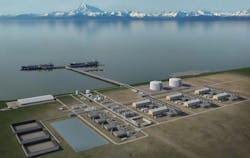
The U.S. liquified natural gas export revolution mostly happening along the Gulf of Mexico coastline is expanding to the edge of the nation’s upper northwest boundary.
LNG developer Glenfarne has finalized a partnership with steel producer POSCO International Corp. to build the Alaska LNG Project terminal along the Pacific Coast. POSCO will provide steel for the 807-mile, 42-inch pressurized pipeline to bring natural gas produced from Alaska’s North Slope fields.
Glenfarne already has secured preliminary commercial LNG supply deals with customers from Japan, Korea, Taiwan and Thailand totaling about 11 million metric tons per year.
“POSCO Group is one of the world’s leading steel and energy companies, and their commitment to Alaska LNG reflects the high degree of support in Asia and across the Pacific for unlocking this valuable source of abundant, competitive LNG,” said Brendan Duval, Glenfarne CEO and founder, in a statement. “Our partnership represents an important milestone in Glenfarne’s progress developing this project, backed by strong industry support and engagement.”
The U.S. began commercial exporting domestic natural gas as LNG in 2016 and has become the world’s largest exporter with more than 15 billion cubic feet per day of capacity as of this summer. LNG is natural gas chilled to liquify it and make it stable for shipping.
Most of the nation’s biggest LNG liquefaction and export terminals are located along the Louisiana and Texas coastlines with the Gulf of Mexico. These include Cheniere Energy’s Sabine Pass, which moves close to 29 million metric tons of LNG annually, to the Freeport, Corpus Christi and Calcasieu Pass terminals operated, respectively, by Zachary Hastings, Sempra Energy and Venture Global LNG.
Record amounts of natural gas are being produced in continental U.S. fields such as the Bakken, Marcellus, Utica shales and Permian Basin. At the same time, the Alaska North Slope wells reportedly possess about 35 trillion cubic feet of proven natural gas reserves.
POSCO, in addition to being South Korea’s largest steel producer, is a major LNG importer. The Alaska LNG project is a joint venture with Glenfarne and the state-owned Alaska Gasline Development Corp.
Glenfarne also is partnering with oilfield services firm Baker Hughes, which will provide LNG compression and power generation technology for the project. Baker Hughes also is an investor in Alaska LNG.
Although many of the world’s biggest companies have been moving toward decarbonization of their facility power generation and supply chains, the rise of demand for new cloud-based computing, industrial electrification and artificial intelligence is driving both energy firms and customers to step up natural gas-fired project commitments.
Natural gas offers baseload and flexible power capacity, plus the U.S. has been a leading producer since the scaling up of the shale plays more than 20 years ago. Data center developers such as Fermi America and Fundamental Data are signing supply deals for natural gas in West Virginia and Texas, respectively.
About the Author
EnergyTech Staff
Rod Walton is head of content for EnergyTech.com. He has spent 17 years covering the energy industry as a newspaper and trade journalist.
Walton formerly was energy writer and business editor at the Tulsa World. Later, he spent six years covering the electricity power sector for Pennwell and Clarion Events. He joined Endeavor and EnergyTech in November 2021.
He can be reached at [email protected].
EnergyTech is focused on the mission critical and large-scale energy users and their sustainability and resiliency goals. These include the commercial and industrial sectors, as well as the military, universities, data centers and microgrids.
Many large-scale energy users such as Fortune 500 companies, and mission-critical users such as military bases, universities, healthcare facilities, public safety and data centers, shifting their energy priorities to reach net-zero carbon goals within the coming decades. These include plans for renewable energy power purchase agreements, but also on-site resiliency projects such as microgrids, combined heat and power, rooftop solar, energy storage, digitalization and building efficiency upgrades.