Advancing Space Exploration: The U.S. Moon Shot for Sustainable Lunar Power
Key Highlights
- - The U.S. aims to deploy a lunar surface nuclear reactor by 2030 to support extended human missions on the moon.
- - Challenges include low gravity, lack of water for cooling, and extreme temperature fluctuations, which require innovative engineering solutions.
- - Major aerospace and energy companies like Lockheed Martin, Westinghouse, and Boeing are involved in developing lunar reactor technology.
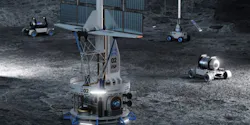
Talk about your moon shots: The U.S. Department of Energy (DOE) and National Aeronautics and Space Administration (NASA) are renewing their commitment to jointly researching and developing plans for a nuclear fission reactor as a sustainable energy resource for future lunar missions.
The R&D also could aid NASA in potential future missions to Mars, according to the statement.
President Trump has said he wants to deploy a lunar surface reactor by 2030.
“History shows that when American science and innovation come together, from the Manhattan Project to the Apollo Mission, our nation leads the world to reach new frontiers once thought impossible,” said U.S. Secretary of Energy Chris Wright in the joint statement. “This agreement continues that legacy.”
Nuclear reactors can produce carbon-free and baseload electrical power at high-capacity rates without the need for refueling for more than a year. Such reliable and high-capacity fission power would help sustain extended human missions on the moon.
Landing that dream safely is another matter.
The logistical challenges to make nuclear fission work on the lunar surface, of course, are many. Low gravity, lack of air and convection, as well as a lack of water for cooling, are among the engineering and atmospheric roadblocks to nuclear power on the moon. That’s not including vast temperature changes ranging from hundreds of degrees plus and minus zero.
Yet the U.S. is not alone in pursuing the engineering marvel of lunar surface reactors. Russia and China are exploring moon reactor concepts, while next-generation nuclear reactor designers working for the U.S., such as X-energy, are touting the potential for long-term, high-production fission energy to power human endeavors.
“Building and operating a moonbase, especially one that will be involved with industrial processes like mining and water extraction, requires a lot of energy,” reads X-energy’s “Space” page on the company’s website. “If astronauts are ever going to live and work near the lunar south pole or anywhere on the moon they’re going to need nuclear energy to provide a reliable source of baseload power.”
NASA and DOE signed a memorandum of understanding to collaborate on making lunar surface reactors a reality. The agencies’ joint effort to develop, fuel, authorize, and ready a lunar surface reactor for launch is backed by more than 50 years of collaboration in support of space exploration, technology development and national security, according to the joint announcement.
“Under President Trump’s national space policy, America is committed to returning to the moon, building the infrastructure to stay, and making the investments required for the next giant leap to Mars and beyond,” said NASA Administrator Jared Isaacman. “This agreement enables closer collaboration between NASA and the Department of Energy to deliver the capabilities necessary to usher in the Golden Age of space exploration and discovery.”
Companies which are working on solving the lunar reactor technology and engineering challenges include Lockheed Martin, Westinghouse, X-energy, BWXT, Rolls-Royce and Boeing.
About the Author
 Rod Walton, EnergyTech Managing Editor
Rod Walton, EnergyTech Managing Editor
Managing Editor
For EnergyTech editorial inquiries, please contact Managing Editor Rod Walton at [email protected].
Rod Walton has spent 17 years covering the energy industry as a newspaper and trade journalist. He formerly was energy writer and business editor at the Tulsa World. Later, he spent six years covering the electricity power sector for Pennwell and Clarion Events. He joined Endeavor and EnergyTech in November 2021.
Walton earned his Bachelors degree in journalism from the University of Oklahoma. His career stops include the Moore American, Bartlesville Examiner-Enterprise, Wagoner Tribune and Tulsa World.
EnergyTech is focused on the mission critical and large-scale energy users and their sustainability and resiliency goals. These include the commercial and industrial sectors, as well as the military, universities, data centers and microgrids. The C&I sectors together account for close to 30 percent of greenhouse gas emissions in the U.S.
He was named Managing Editor for Microgrid Knowledge and EnergyTech starting July 1, 2023
Many large-scale energy users such as Fortune 500 companies, and mission-critical users such as military bases, universities, healthcare facilities, public safety and data centers, shifting their energy priorities to reach net-zero carbon goals within the coming decades. These include plans for renewable energy power purchase agreements, but also on-site resiliency projects such as microgrids, combined heat and power, rooftop solar, energy storage, digitalization and building efficiency upgrades.