A Global Nuclear Energy Revolution Could Happen One Small Fusion at a Time

What if the holy grail of energy was already here?
Reality check: It’s still a moon shot on a massive scale. At a smaller scale, though, it’s already in action and doing critically good things, achieving transformative purposes for humankind.
If we’re being vague let’s clear up the mystery and confirm we’re talking about nuclear fusion. Remember: The power of the sun in the palm of our hand.
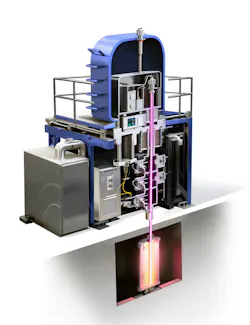
Nuclear fusion is the true end game for so many researchers and long-term energy investors today. Bringing it into utility-scale and terawatt-level activation is the dream of researchers from Lawrence Livermore National Lab in California to ITER collaborators in Europe, not to mention an eager and hungry lineup of fusion startups and energy-hungry digital infrastructure customers.
But that vision is so far from scale right now. We all want nuclear fusion, the idea of limitless and carbon-free energy to transform both our economics and environment. Truth is, the moon shot is probably decades away, at least, but fusion is in action today at multiple and not so net energy levels.
Companies such as SHINE Technologies are taking nuclear fusion where it’s at and moving forward one step at a time. This is mission- critical stuff which, by steady learning and growing, could help reach that moon shot like a power generation Artemis mission.
The Wisconsin-based company is doing fusion on an everyday, operative level to create value in producing isotopes for nuclear medicine, neutron imaging for military parts such as jet turbine blades and ejection system bolts.
“Our mission is to commercialize fusion ultimately with the goal of making cheap energy,” SHINE founder and CEO Greg Piefer told EnergyTech.com in an exclusive interview. “Our path to doing that is through commercialization rather than trying to make a big scientific moon shot.”
So that may not garner major headlines, but it makes a world of difference to cancer patients and military pilots.
“What SHINE really is, is an obviously incredibly important medical business,” he added. “But perhaps even more significantly for humankind over the long run it is continued proof that the cost of nuclear fusion can scale through that commercialization, and eventually that will lead us to the promised land for cheap and abundant energy.”
As the U.S. and world try to catch up with a racing cloud-based computing and artificial intelligence sector seeking to break free of current energy constraints, nuclear fusion at scale is still a bit of a pipe dream, but one which attracts massive investment from both the private and government sectors worldwide.
The Fusion Industry Association reported last year that about $2.64 billion in private and public funding for fusion research and development was raised in the 12 months ending with July 2025. A large part of that whole includes massive, nearly billion-dollar-level equity deals for startups aiming highest first, so to speak.
Yet among the dozens of fusion startups seeking utility-scale dreams, there are a handful currently using fusion at a smaller scale to create medicines and performing radiographic functions for customers.

SHINE Technologies is one of those latter subsets of fusion companies. Its work has attracted enough key attention to merit a $263 million conditional loan guarantee from the U.S. Department of Energy to complete its planned Chrysalis facility in Janesville, Wisconsin. Chrysalis, once completed in about two years, could be the largest nuclear isotope facility globally and producing valuable medical isotopes such as molybdenum-99, iodine-131, xenon-133 and others.
“When people think of fusion they think of commercial fusion energy,” Piefer said. “Fusion doesn’t have to be used just for energy.”
SHINE Technologies utilizes a simpler iteration of fusion involving tritium and deuterium. Its fusion process creates value from produced isotopes, neutrons and soon, nuclear waste from conventional fission reactor plants.
“We’re in that world but we’re a little simpler,” Piefer pointed out. “We can be a little simpler because we don’t need to produce net energy. We can be a net energy loser and still create tremendous value.”
The value is seen at the private equity level, too. Only two months ago. SHINE raised $240 million in an equity funding round that included investors Nantworks, Fidelity Management and Research, Sumitomo, Pelican Energy Partners, Deerfield Management and Oaktree Capital Management, among others.
SHINE has been around for 15 years and has gradually expanded its scope. The vision of the company and its founder have broadened beyond medical purposes and materials testing to create next-gen value from recycled fission waste to generate heat and, the moon shot itself, commercial power generation.
“It’s all related by the same technological engine and same core processes,” Piefer said of the plans for the Chrysalis facility and other SHINE work. “There are four core steps in that plant–dissolve uranium, hit it with fusion neutrons, turn that uranium into important things, separate those, and then reuse.”
Burning the last level of nuclear waste will create commercial-scale heat that can be sold for making electricity.
“It can provide the first fusion energy on the grid, because it’s subsidized by the service business that sits underneath it,” he added. “It drives down the cost to where fusion can make money as a standalone.”
Small-scale fusion companies do the deed in much the same way as the big laser and confinement experiments at Livermore and other sites. They shoot deuterium into tritium and create fusion at lower temperatures that don’t require a massive confinement system.
“We don’t need a super sophisticated confinement system,” Piefer said. “We do care about net energy but it’s down the road. We care about making a net value for humans.”
In that way nuclear fusion is not a future dream. Nuclear fusion is now and is delivering on value while working its way up to the vision of transformative power.
About the Author
 Rod Walton, EnergyTech Managing Editor
Rod Walton, EnergyTech Managing Editor
Managing Editor
For EnergyTech editorial inquiries, please contact Managing Editor Rod Walton at [email protected].
Rod Walton has spent 17 years covering the energy industry as a newspaper and trade journalist. He formerly was energy writer and business editor at the Tulsa World. Later, he spent six years covering the electricity power sector for Pennwell and Clarion Events. He joined Endeavor and EnergyTech in November 2021.
Walton earned his Bachelors degree in journalism from the University of Oklahoma. His career stops include the Moore American, Bartlesville Examiner-Enterprise, Wagoner Tribune and Tulsa World.
EnergyTech is focused on the mission critical and large-scale energy users and their sustainability and resiliency goals. These include the commercial and industrial sectors, as well as the military, universities, data centers and microgrids. The C&I sectors together account for close to 30 percent of greenhouse gas emissions in the U.S.
He was named Managing Editor for Microgrid Knowledge and EnergyTech starting July 1, 2023
Many large-scale energy users such as Fortune 500 companies, and mission-critical users such as military bases, universities, healthcare facilities, public safety and data centers, shifting their energy priorities to reach net-zero carbon goals within the coming decades. These include plans for renewable energy power purchase agreements, but also on-site resiliency projects such as microgrids, combined heat and power, rooftop solar, energy storage, digitalization and building efficiency upgrades.