Riot Platforms Shifting Bitcoin Focus to Data Computing and Wants to Power AI with SMR Nuclear

Small modular reactor designer Terrestrial Energy was already exploring the frontier of next-gen nuclear power to possibly power a university campus research facility, and now joins the ranks of power generators intensifying their focus on electrifying future artificial intelligence (AI) training and data center load growth.
Bitcoin mining and digital infrastructure developer Riot Platforms has agreed to partner with Terrestrial Energy and customize the latter’s IMSR small nuclear design to be integrated with Riot’s facilities. They are already evaluating the viability of SMRs to power existing Riot facilities in Texas and Kentucky.
“Our data centers require reliable and predictable energy at the scale demanded by today’s hyperscale customers,” said Jason Les, CEO of Riot Platforms, in a statement. “Partnering with Terrestrial Energy positions our facilities at the forefront of data center deployment, utilizing a clean consistent baseload of power required by data centers presents an ideal pairing for development alongside Terrestrial’s IMSR Plants.”
No SMR has been built or even approved to operate in the U.S. yet, but multiple companies such as Terrestrial Energy are working on designs and potential sites. The IMSR reactor design is intended to use standard-assay low-enriched uranium (SALEU) to power fission reactors. SALEU’s is reportedly more readily available than high-assay low-enriched uranium (HALEU), so connecting the fuel resource supply chain will not take that long, the companies say.
Riot Platforms already has operational sites originally built for Bitcoin mining in both Texas and Kentucky. The company has sold some of its Bitcoin to help finance land acquisition and converting its facilities strategy to data computing infrastructure.
Unlock DER Value with Smart Use of DER Assets
New White Paper from PowerSecure
Charlotte-based Terrestrial Energy specializes in work to create the ISMR, which stands for Integral Molten Salt Reactor. The modularized ISMR will be only about 3.6 meters in diameter and 18 meters tall, thus could be transported by trucking and theoretically generate a 400-MW power plant on only about 17 acres.
The ISMR is modeled closely on the denatured molten salt reactor design from the Oak Ridge National Laboratory. Terrestrial’s design is under licensing review with the U.S. Nuclear Regulatory Commission.
“This partnership brings together two companies with sector leading capabilities to unlock the tremendous value in IMSR Plant supply to data center operations and to build long-term strategic depth in Riot Platforms’ power-first strategy,” said Simon Irish, CEO of Terrestrial Energy. “Riot has proven it can build and operate large-scale digital infrastructure, and our small and modular IMSR Plant is designed to deliver the reliable, low-cost power those operations need.”
AI factories require huge amounts of energy capacity, possibly 1 GW or more eventually, a tremendous logistical and environmental challenge for data tech firms which want to grow and yet remain sustainable in their energy consumption. Nuclear fission creates baseload-level electricity without carbon emissions.
Last year Terrestrial Energy detailed a new partnership with on-site power developer and integrator Ameresco as well as research work with Texas A&M University.
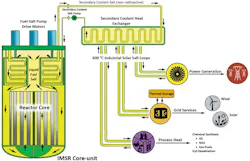
The ISMR is modeled closely on the denatured molten salt reactor design from the Oak Ridge National Laboratory. Terrestrial’s design is under licensing review with the U.S. Nuclear Regulatory Commission.
“This partnership brings together two companies with sector leading capabilities to unlock the tremendous value in IMSR Plant supply to data center operations and to build long-term strategic depth in Riot Platforms’ power-first strategy,” said Simon Irish, CEO of Terrestrial Energy. “Riot has proven it can build and operate large-scale digital infrastructure, and our small and modular IMSR Plant is designed to deliver the reliable, low-cost power those operations need.”
AI factories require huge amounts of energy capacity, possibly 1 GW or more eventually, a tremendous logistical and environmental challenge for data tech firms which want to grow and yet remain sustainable in their energy consumption. Nuclear fission creates baseload-level electricity without carbon emissions.
Last year Terrestrial Energy detailed a new partnership with on-site power developer and integrator Ameresco as well as research work with Texas A&M University.
About the Author
 Rod Walton, EnergyTech Managing Editor
Rod Walton, EnergyTech Managing Editor
Managing Editor
For EnergyTech editorial inquiries, please contact Managing Editor Rod Walton at [email protected].
Rod Walton has spent 17 years covering the energy industry as a newspaper and trade journalist. He formerly was energy writer and business editor at the Tulsa World. Later, he spent six years covering the electricity power sector for Pennwell and Clarion Events. He joined Endeavor and EnergyTech in November 2021.
Walton earned his Bachelors degree in journalism from the University of Oklahoma. His career stops include the Moore American, Bartlesville Examiner-Enterprise, Wagoner Tribune and Tulsa World.
EnergyTech is focused on the mission critical and large-scale energy users and their sustainability and resiliency goals. These include the commercial and industrial sectors, as well as the military, universities, data centers and microgrids. The C&I sectors together account for close to 30 percent of greenhouse gas emissions in the U.S.
He was named Managing Editor for Microgrid Knowledge and EnergyTech starting July 1, 2023
Many large-scale energy users such as Fortune 500 companies, and mission-critical users such as military bases, universities, healthcare facilities, public safety and data centers, shifting their energy priorities to reach net-zero carbon goals within the coming decades. These include plans for renewable energy power purchase agreements, but also on-site resiliency projects such as microgrids, combined heat and power, rooftop solar, energy storage, digitalization and building efficiency upgrades.