SMR Startup Blue Energy, GE Vernova-Hitachi Seek Federal Construction Permit for Gas-Nuclear Hybrid
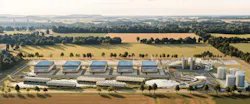
It’s still virtual gigawatts away from fruition, but what might prove to become the world’s first hybrid natural gas and nuclear-energized artificial intelligence data center took one tentative and yet critical step closer to reality this week.
North Carolina-based startup Blue Energy submitted its first construction permit application to the U.S. Nuclear Regulatory Commission. The company hopes to install a GE Vernova-Hitachi Nuclear BWRX-300 small modular reactor (SMR) to power data center developer Crusoe’s AI factory and other loads from the Port of Victoria site in Texas.
GE Vernova is a key partner in Blue Energy’s ambitions. The Port of Victoria project also proposes to combine a GE Vernova 7HA.02 gas turbine with the GE Vernova-Hitachi BWRX-300 SMR and create a 2.5-GW power plant by the early 2030s.
“Blue Energy’s progress through the NRC process is another important step toward deploying the BWRX-300 in the United States,” said Jason Cooper, CEO, GE Vernova Hitachi Nuclear Energy, said in a statement. “This is what fleet deployment looks like: projects advancing on common technology, licensing work and supply chain capabilities, allowing us to apply lessons from one project to the next. With Blue Energy moving forward and the first U.S. BWRX-300 construction permit approaching a decision at Clinch River, we are seeing the foundations of a BWRX-300 fleet take shape in the United States.”
The future of SMRs faces questions of time and expense
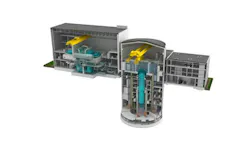
The BWRX-300 is currently undergoing preliminary design and pre-construction processes in partnership with the Tennessee Valley Authority at the Clinch River nuclear site. TVA also has submitted a construction permit application with the NRC.
No SMRs have been fully approved or even started construction in the U.S. yet although billions of dollars are being invested in advanced reactor startups. The Trump Administration’s U.S. Department of Energy has formed a pilot project encouraging SMR and advanced reactor startups to work on accelerating the path toward future operations.
Federal NRC applications usually take years to work through before construction and environmental permits are granted. Other startups such as X-energy also have permit applications before the NRC.
Making progress one step at a time
Even so, taking the project to the federal regulatory level is a milestone for SMR startups.
“This filing is an important step in turning our vision for repeatable, scalable, rapidly built new nuclear into a real project,” said Jake Jurewicz, CEO and co-founder of Blue Energy. “Our team has moved from technology selection to the NRC construction permitting process in a matter of months, and we are proud of the progress we are making with GE Vernova. We believe combining Blue Energy’s approach to project development and construction with the BWRX-300 can create a faster, more repeatable path to deploying new nuclear power in the United States.”
Nuclear reactors do not generate carbon emissions at the point of use. Blue Energy selected the BWRX-300 design to co-locate with the gas turbine earlier this year.
The Port of Victoria project’s first phase would focus on the gas turbines which are the quickest to get installed and commissioned by the end of this decade. The second phase would include perhaps five BWRX-300 units (generating close to 300 MW each at capacity).
Eventually, the SMR deployment would handle the majority of Blue Energy’s power generation capacity, and the gas-fired units would be phased out or reduced to eliminate greenhouse gas emissions even further.
The cost of the project is estimated at more than $6 billion. French multinational banking firm Société Générale is leading financial advisor for Blue Energy on the Port of Victoria plan, while other strategic investors in the company include Constellation Technology Ventures, VXI, Engine Ventures, At One Ventures and Tamarack Global.
“We are excited to partner with Blue Energy on this groundbreaking mandate, which represents an important milestone in unlocking the ability to deploy private capital markets that can accelerate advanced nuclear just like it has for wind, solar, and battery technologies, to meet the world’s evolving energy and infrastructure needs,” said Kim Hill, transaction lead at Société Générale.
Conventional nuclear energy accounts for about 18% of the U.S. utility-scale electricity resource mix, according to federal statistics. The industry was waning under the pressure of higher operational costs, competition from natural gas and renewables as well as flat load growth for years.
However, the rise of data center supercomputing–including AI and industrial automation demands–are creating a perceived power crisis which threatens both grid stability and sustainability goals. Many industry leaders contend that carbon-free nuclear energy offers a baseload and sustainable solution.
Opponents say that SMR and any nuclear power plants are too expensive, time-consuming and raise health and safety concerns.
About the Author
 Rod Walton, EnergyTech Managing Editor
Rod Walton, EnergyTech Managing Editor
Managing Editor
For EnergyTech editorial inquiries, please contact Managing Editor Rod Walton at [email protected].
Rod Walton has spent 17 years covering the energy industry as a newspaper and trade journalist. He formerly was energy writer and business editor at the Tulsa World. Later, he spent six years covering the electricity power sector for Pennwell and Clarion Events. He joined Endeavor and EnergyTech in November 2021.
Walton earned his Bachelors degree in journalism from the University of Oklahoma. His career stops include the Moore American, Bartlesville Examiner-Enterprise, Wagoner Tribune and Tulsa World.
EnergyTech is focused on the mission critical and large-scale energy users and their sustainability and resiliency goals. These include the commercial and industrial sectors, as well as the military, universities, data centers and microgrids. The C&I sectors together account for close to 30 percent of greenhouse gas emissions in the U.S.
He was named Managing Editor for Microgrid Knowledge and EnergyTech starting July 1, 2023
Many large-scale energy users such as Fortune 500 companies, and mission-critical users such as military bases, universities, healthcare facilities, public safety and data centers, shifting their energy priorities to reach net-zero carbon goals within the coming decades. These include plans for renewable energy power purchase agreements, but also on-site resiliency projects such as microgrids, combined heat and power, rooftop solar, energy storage, digitalization and building efficiency upgrades.