Standing on Its Own: Why Solar Is the Next Commodity
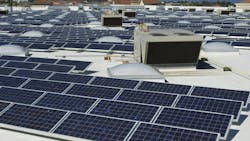
Commercial solar power has been available for decades, but in recent years, it has emerged from the shadows.
Solar has seen massive growth since 2010, according to the Solar Energy Industries Association. There are now 255 gigawatts (GW) direct-current of solar capacity installed in the United States, enough to power over 43 million homes.
Its growth accelerated in 2024, when developers added a record-breaking 30 GW of utility-scale solar to the U.S. grid. Solar accounted for 61% of electric-generating capacity additions, according to the U.S. Energy Information Administration (EIA). The trend has continued this year, with the expected addition of 32.5 GW.
Despite the accelerated phaseout of renewable energy tax credits, solar isn’t going anywhere. It plays a significant role in the decarbonization of electricity and the broader energy system. In fact, solar has positioned itself to stand on its own two feet and become the next great energy commodity, driven by speed, scale, standardization, and the rising power of storage.
Cost and consistency are fueling the climb
Solar power is a technology that has gone from promising to productive. It’s available, and it’s cheap.
According to the Lawrence Berkeley National Laboratory, installed costs for utility-scale solar PV have decreased by 73% since 2010. Solar is now one of the most cost-effective new power sources, as measured by the levelized cost of electricity, which calculates the average net present cost of electricity generation for a plant over its lifetime.
This is the result of a virtuous cycle of policy support and technological advancements. Government incentives, such as tax credits and subsidies, have reduced the high upfront capital investment. As costs decreased, governments became more ambitious and drove costs even lower.
At the same time, solar panels are lighter, more efficient, and cheaper to produce. Hardware has also become far more standardized. Module performance, warranties, and installation methods are now largely uniform across vendors. That predictability makes solar easier to finance, price, and plan, ultimately unlocking a key commodity trait: interchangeability.
Even better, solar is no longer confined to the sunniest states. According to the Berkeley laboratory, as the economics of solar have fundamentally changed, utility-scale projects are now common in states with a history of cold winters and cloud cover. States in the Midwest and Northeast are seeing increasing numbers of large solar farms. This kind of geographic flexibility is exactly what allows a resource to scale nationally.
Storage is intermittency’s saving grace
Solar’s biggest hurdle has always been intermittency. No sun, no power. That made it a hard sell as a primary source of energy, let alone a commodity. But that’s all changing fast.
Pairing solar with storage turns a variable energy source into something far more powerful: a controllable, dispatchable asset. You can store solar energy when prices are low, such as during midday oversupply, and sell it back to the grid when prices spike in the evening. That’s arbitrage, and it’s already reshaping energy economics in places like California, where curtailment and negative pricing have become daily realities.
In 2024, power providers added a record 10.3 GW of battery storage to the U.S. grid. In 2025, the EIA expects another 18.2 GW, nearly doubling the total from the previous year. One exciting trend is the development of solar farms with integrated battery storage.
Buyers are demanding reliable, time-sensitive energy. Grid operators are planning around it. What was once a clean energy alternative is quickly becoming a market-ready asset class.
Challenges won’t stop progress
Of course, solar isn’t a perfect commodity yet. Weather still impacts generation, and not every region has the infrastructure to handle high-penetration solar. Many projects still rely on long-term power purchase agreements (PPAs) for guaranteed returns.
But those are problems we can solve. The industry is achieving this through smarter forecasting, improved grid integration, and a more flexible approach to project finance. For solar to behave like a true commodity, it needs liquidity, price transparency, and regional trade capabilities. We’re not quite there yet, but the trajectory is clear.
Solar’s next phase is well underway
As tax credits wind down, solar energy is entering its next phase, where it will be tested to see if it can continue to grow. But the signs are more than promising.
Costs are stable, technology is mature, storage is scaling, and the market is shifting from “if” to “how fast.” So what comes next?
● Solar traded without long-term PPAs
● Arbitrage becoming a built-in strategy
● Buyers focused on timing and reliability, not just energy volume
● Grid operators treating solar-storage as firm capacity, not a sidekick
Solar is no longer just a clean energy option. Instead, with its momentum, maturity, and growing role in the real-time market, solar is a competitive energy commodity in the making.
About the Author
Brian Nelson
Brian Nelson is the U.S. Renewables Segment Lead at ABB Electrification