Pennsylvania Water Utility Trying In-Pipe, Low-Volume Hydropower to Decarbonize System
The growth of utility-scale hydro-electric power projects has slowed in the U.S. over recent decades, but a public water utility in Pennsylvania is going to utilize its water intake to create electricity in the near future.
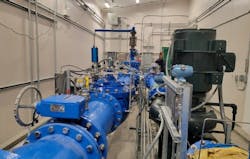
St. Mary’s Area Water Authority is contracting New York-based Rentricity to develop an in-conduit (in-pipe) hydropower system connecting with the authority’s raw water intake line.
The project will help decarbonize some of St. Mary’s water-utility power consumption, while generating approximately 157,680 kWh of carbon-free electricity annually, equivalent to powering 12 homes per year or removing 13 gasoline cars from the road.
St. Mary’s In-Conduit Hydropower Project will install Rentricity’s proprietary Flow-to-Wire turbine generator system to the raw water line operating at about 26 PSI (or less than 60 feet of head). It will be Rentricity’s lowest-pressure Flow-to-Wire installation among its 30 or so projects since the company’s inception.
"This project with St. Mary's demonstrates how existing municipal systems can become distributed clean energy producers, helping communities' lower costs, reduce emissions, and build resilience into the grid,” said Frank Zammataro, CEO and Co-Founder of Rentricity, in a statement. “As data centers and AI systems drive future energy demand, energy recovery solutions like this will play an essential role."
The water authority serves the city of St. Mary's, which has nearly 13,000 residents, and surrounding communities within or near Elk County.
Rentricity's in-conduit hydropower technology captures the energy from pressure-reducing points in water systems and converts excess flow into renewable power, reducing the load on regional grids while providing a new revenue stream for utilities.
Read full coverage of Distributed Energy Projects in EnergyTech
Over its planned 40-year life cycle, the system is designed to offset more than 2,400 metric tons of carbon dioxide equivalent, along with reductions in sulfur dioxide and nitrogen oxides, contributing directly to Pennsylvania's greenhouse gas reduction and clean air goals.
Rentricity's Flow-to-Wire systems are NSF 61/372-certified for use in drinking water and available for irrigation and industrial applications. Each installation is custom-engineered to the site's hydraulics, maximizing power recovery and operational performance.
Rentricity has completed more than 30 projects across North America and is expanding in-conduit hydropower as an intersection of water management, clean energy generation, climate policy, and infrastructure resilience. Among its projects include work with the Ute Tribe Farm in Colorado and the Pyramid Water Treatment Plant in Alaska.
Hydropower is perhaps the oldest utility-scale renewable energy resource within the U.S. electricity mix and currently generates slightly less than 6% of total U.S. utility-scale electricity generation. It accounts for 27% of total U.S. renewable power generation, according to the federal Department of Energy.
About the Author
EnergyTech Staff
Rod Walton is head of content for EnergyTech.com. He has spent 17 years covering the energy industry as a newspaper and trade journalist.
Walton formerly was energy writer and business editor at the Tulsa World. Later, he spent six years covering the electricity power sector for Pennwell and Clarion Events. He joined Endeavor and EnergyTech in November 2021.
He can be reached at [email protected].
EnergyTech is focused on the mission critical and large-scale energy users and their sustainability and resiliency goals. These include the commercial and industrial sectors, as well as the military, universities, data centers and microgrids.
Many large-scale energy users such as Fortune 500 companies, and mission-critical users such as military bases, universities, healthcare facilities, public safety and data centers, shifting their energy priorities to reach net-zero carbon goals within the coming decades. These include plans for renewable energy power purchase agreements, but also on-site resiliency projects such as microgrids, combined heat and power, rooftop solar, energy storage, digitalization and building efficiency upgrades.