GE Vernova Repowers US Onshore Wind Growth with 1.1 GW of New Orders
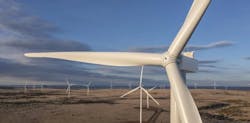
Offshore wind is facing headwinds—yes, pun intended—in the U.S. due to regulatory opposition by the Trump Administration, but the onshore wind supply chain is spinning forward at brisk financial and project development rates.
Turbine maker GE Vernova announced that its onshore wind business has received orders to power 1.1 GW of turbine capacity in the U.S. All the orders were booked in 2025, but these repower projects are expected to reach commercial operation dates this year and next, according to the release.
“By deploying our state-of-the-art repower solutions, we enable our customers to achieve increased energy production, significantly enhance asset reliability, reduce operational and maintenance costs, and extend the overall lifespan of their wind farms,” said Uzair Memon, Chief Commercial Officer for GE Vernova’s Onshore Wind Services business, in a statement. “This directly aligns with our commitment to making existing renewable infrastructure more productive and sustainable for the long term, while also bolstering U.S. manufacturing and job creation.”
Repowering is upgrading and refurbishing existing onshore wind power plants. Repowering can increase size, output and longevity of existing turbines.
“A repower project enables us to rejuvenate a wind farm to increase annual energy production, extend life, and improve project availability,” said David Hardy, GE Vernova’s Chief Commercial Officer for Wind. “These projects are rooted in deep, long-term customer partnerships, where we work closely together to provide solutions that maximize performance and long-term value.”
GE Vernova's Onshore Wind business has a total installed base of approximately 59,000 turbines and nearly 120 GW of installed capacity worldwide. The company’s product portfolio offers the next-generation high-powered turbines at scale that drive decarbonization through high-quality, more affordable, and sustainable renewable energy.
Aula Energy recently signed a deal with GE Vernova to provide 42 6.1-MW turbines for the Carmody’s Hill Wind Farm in Australia. GE Vernova also is supply wind turbines for Aula’s Boulder Creek Wind Farm in Queensland.
Offshore wind development also is flourishing in Europe and Asia. The U.S. Department of Interior has opposed five offshore wind projects already well into construction on the U.S. east coast, even ordering them to stop work toward completion.
Federal Judges have granted preliminary injunctions against all of those DOI orders, allow work to resume on the Sunrise, Revolution, Vineyard, Coastal Virginia and Empire offshore projects.
The U.S. Energy Information Administration estimated that utility-scale wind energy installed capacity grew about 11% in the two years ending 2025. Last year’s wind power generation totaled nearly 480 billion kWh, according to the EIA
Paralyzed by Digital Transformation? Start Here
New EnergyTech.com Webinar Featuring Experts from Siemens
Happening Live 2 p.m. ET Tuesday, March 10
About the Author
EnergyTech Staff
Rod Walton is head of content for EnergyTech.com. He has spent 17 years covering the energy industry as a newspaper and trade journalist.
Walton formerly was energy writer and business editor at the Tulsa World. Later, he spent six years covering the electricity power sector for Pennwell and Clarion Events. He joined Endeavor and EnergyTech in November 2021.
He can be reached at [email protected].
EnergyTech is focused on the mission critical and large-scale energy users and their sustainability and resiliency goals. These include the commercial and industrial sectors, as well as the military, universities, data centers and microgrids.
Many large-scale energy users such as Fortune 500 companies, and mission-critical users such as military bases, universities, healthcare facilities, public safety and data centers, shifting their energy priorities to reach net-zero carbon goals within the coming decades. These include plans for renewable energy power purchase agreements, but also on-site resiliency projects such as microgrids, combined heat and power, rooftop solar, energy storage, digitalization and building efficiency upgrades.