ForeFront Power, Standard Solar Expanding New Mexico PV Arrays
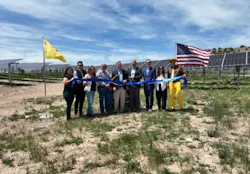
Solar developers ForeFront Power and Standard Solar recently gathered to highlight progress across an eight-project, 48.4 MW portfolio in Las Vegas, New Mexico.
The 7.5-MW Pino community solar site, originally developed by New Mexico-based Pluma Construction, was acquired in March as part of a broader Standard Solar commitment to New Mexico. Solstice Power Technologies, which specializes in connecting local communities with shared solar photovoltaic (PV) farms, will help lead subscriber acquisitions for the portfolio.
Forefront Power serves as an advisor and co-developer to Standard Solar in these development efforts, as the company states it is actively acquiring additional projects with similar focuses.
The final eighth project in this portfolio, Otero (5.2 MW), in Alamogordo, New Mexico, is expected to be completed by the end of 2026. The other six project locations are listed as:
- Curry Road North (4.5 MW)— Clovis, NM
- Clovis (5.1 MW) — Clovis, NM
- Las Cruces (7.6 MW)— Las Cruces, NM
- Lordsburg (5.0 MW) — Lordsburg, NM
- Reynolds (7.0 MW) — Reynolds, NM
- Silver City (6.5 MW) — Silver City, NM
Once fully complete, the eight solar sites could generate about 103,287 MWh in the first year of operations across both state trust lands and privately sited facilities. The sites will focus on using single-axis tracker systems which are considered more efficient and aimed at helping reduce utility costs for New Mexican households.
By optimizing solar panel orientation throughout the day, single-axis trackers reportedly increase energy production by up to 25% compared to fixed installations. Community solar is becoming a popular option for this adoption as it allows multiple subscribers to share the benefits of a single off-site solar array that sends electricity through a meter to the utility grid.
Community solar presents a less expensive way for consumers to participate in solar generation compared to residential rooftop installations, and is more direct than remote utility-scale projects.
According to Technavio, the single-axis solar photovoltaic (PV) tracker market is expected to increase by more than $13 billion due to declining costs of solar generation and increased adoption of microgrids. The research firm added that North America accounted for 36% of this market growth.
By optimizing solar panel orientation throughout the day, single-axis trackers reportedly increase energy production by up to 25% compared to fixed installations. Community solar is becoming a popular option for this adoption as it allows multiple subscribers to share the benefits of a single off-site solar array that sends electricity through a meter to the utility grid.
Community solar presents a less expensive way for consumers to participate in solar generation compared to residential rooftop installations, and is more direct than remote utility-scale projects.
Unlock DER Value with Smart Use of DER Assets
New White Paper by PowerSecure
About the Author
EnergyTech Staff
Rod Walton is head of content for EnergyTech.com. He has spent 17 years covering the energy industry as a newspaper and trade journalist.
Walton formerly was energy writer and business editor at the Tulsa World. Later, he spent six years covering the electricity power sector for Pennwell and Clarion Events. He joined Endeavor and EnergyTech in November 2021.
He can be reached at [email protected].
EnergyTech is focused on the mission critical and large-scale energy users and their sustainability and resiliency goals. These include the commercial and industrial sectors, as well as the military, universities, data centers and microgrids.
Many large-scale energy users such as Fortune 500 companies, and mission-critical users such as military bases, universities, healthcare facilities, public safety and data centers, shifting their energy priorities to reach net-zero carbon goals within the coming decades. These include plans for renewable energy power purchase agreements, but also on-site resiliency projects such as microgrids, combined heat and power, rooftop solar, energy storage, digitalization and building efficiency upgrades.