Cypress Creek Breaks Ground on 5.4-GW Solar-Storage Hub to Power Google, Regional Grid in Arkansas
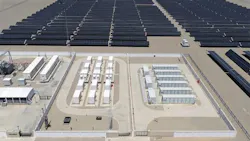
Independent power producer and developer Cypress Creek Energy is teaming up with tech giant Google to bring online what is being labeled as the nation’s largest solar energy project to date.
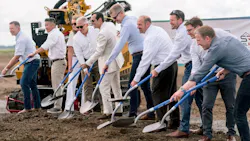
On Tuesday, project partners and officials gathered to break ground on Phases 1 and 2 of the Steel River Energy Center in Mississippi County, Arkansas, which will add 1.63 GW of solar and 1.9 GW of battery storage to the regional grid. The two companies aim to address the growing electricity demand in the U.S. while strengthening Arkansas’s position in domestic energy and manufacturing supply chains.
Once fully complete, the Steel River Energy Center will include 2.5 GW of solar and 2.9 GW of battery storage by 2029 and will support 700 construction jobs according to a release. It’s the equivalent of enough electricity to power more than 315,000 Arkansas homes annually.
Under a power purchase agreement (PPA), Google is securing energy from project owner and operator Cypress Creek for the first two phases of the project. In June, an initial $3.5 billion investment was arranged by Barclays, BNP Paribas, Santander and Wells Fargo to support construction and long-term operation of the project’s first two phases.
The hyperscaler is working to source around-the-clock local carbon-free energy for its developing data centers in Arkansas. Those projects include a $4 billion, 1,100-acre data center campus in West Memphis and a $1 billion, 300,000-square-foot project at the Port of Little Rock, according to the Arkansas Democrat-Gazette (although Google hasn’t officially announced its involvement).
“Steel River not only represents an important investment in Google’s clean energy commitments, but also in our commitment to Arkansas,” said Will Conkling, head of data center energy at Google, in a statement.
Google adds that the Steel River project is a “game changer” for pairing massive solar arrays with advanced battery storage to tackle energy intermittency. The International Energy Agency (IEA) highlights that solving the fluctuation of power output from renewable sources when weather conditions permit is one of the biggest bottlenecks for the clean energy transition and growth of AI data centers.
Steel River will be capable of storing the sun’s peak daytime output—feeding it back into the grid when needed most to boost energy reliability, strengthen grid resiliency and lower consumer costs.
PACO Steel of Arkansas will reportedly provide over 400,000 steel piles manufactured in Blytheville using more than 142,000 tons of steel coils produced at U.S. Steel’s Big River Steel facility in Osceola.
Atop those piles are solar trackers produced by California energy tech company Nextpower. Arizona-based First Solar will domestically manufacture 100% of its solar panels for Steel River.
LG Energy Solution Vertech, a global manufacturer of advanced lithium-ion batteries, is assembling Steel River’s battery energy storage systems using cells manufactured predominantly at U.S. factories.
Over the project’s lifetime, Cypress Creek estimates the Steel River Energy Center to generate roughly $300 million in new tax revenue to benefit local schools and other community-related priorities.
“Some people still question whether a domestic solar supply chain is possible. This project is proof,” said Cypress Creek Energy CEO Kevin Smith. “Steel River is the largest solar project with energy storage in the country, and it’s being built with 100% U.S.-made solar panels and structural steel. That’s good for American manufacturing, good for Arkansas, and good for the country’s energy future.”
According to Solar Energy Industries Association’s Q2 2026 Market Insight Report, solar and battery storage accounted for 91% of all new electricity-generating capacity added in the U.S. Solar alone accounted for 60% of all new capacity.
About the Author
 Eric Moody