Danone Repurposing Yogurt Production Waste into 50B Btus of Biogas Daily
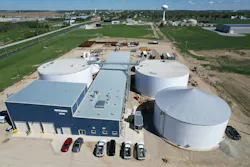
Yogurt maker Danone is going to pipe its organic food production residuals and wastewater to an Ohio treatment facility which will convert that waste into biogas and offset the food company’s conventional natural gas consumption.
PurposeEnergy has commissioned its industrial food waste and wastewater pre-treatment facility in the village of Minster. The $40 million anaerobic digestion facility will offtake the waste residuals from Danone USA’s largest yogurt manufacturing facility and turn it into renewable biogas.
The roundtrip decarbonization work will take up to 250,000 gallons of Danone waste per day to produce about 50,000 million British thermal units-equivalent of biogas. The fuel then is piped back to a dedicated boiler at Danone’s Minster plant, where it will displace conventional methane natural gas.
"Food manufacturers shouldn't have to choose between growing production and meeting their environmental commitments,” PurposeEnergy founder and CEO Eric Fitch said in a statement. “With this facility anchored near Danone's Minster plant, we can give our partner a solution that supports both their goals."
While the Purpose Energy digester is operational in Minster, the company is still ramping up production levels and plans to hold a grand opening in the spring.
If optimally decarbonized, the project could displace the equivalent of about 3,200 U.S. tons of carbon dioxide equivalent per year. Danone produces close to 2.2 million pounds of yogurt daily at the Minster manufacturing plant, according to reports.
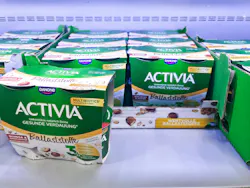
Last year, the company announced it was expanding the Minster facility by 48,000 square feet. The Minster lines produce dairy products under the Dannon, Activia, Oikos and Danimals brands
Earlier this fall, Danone released an updated report on its Impact Journey sustainability goals, including achieving a 30% reduction in methane emissions from milk-dairy production by 2030, (vs. 2020 statistics). The company also plans to reach net zero methane emissions by the end of 2050.
"The PurposeEnergy facility is an example of our Danone Impact Journey in action and part of our wider Re-Fuel energy excellence program, helping turn organic material from our Minster plant into renewable biogas that can be piped back to the plant and used through a new biogas boiler,” Danone Americas COO Heiko Gerling said. “What makes this project especially meaningful is how it brings together industry, local infrastructure, and community stakeholders around a shared goal. It is a powerful example of how operational growth and environmental stewardship can go hand in hand.”
The global agrifood industry emits more than 16 billion metric tons of greenhouse gases annually, according to multiple reports. Close to 10% of global GHS emissions arise from food and organic waste rotting in landfills, according to NHK, the United Nations and other health organizations.
The U.S. currently has close to 2,600 operational biogas capture facilities with the potential for thousands more, according to the American Biogas Council. Some $2.1 billion was invested in the energy potential of food waste in 2025.
About the Author
 Rod Walton, EnergyTech Managing Editor
Managing Editor
For EnergyTech editorial inquiries, please contact Managing Editor Rod Walton at [email protected].
Rod Walton has spent 17 years covering the energy industry as a newspaper and trade journalist. He formerly was energy writer and business editor at the Tulsa World. Later, he spent six years covering the electricity power sector for Pennwell and Clarion Events. He joined Endeavor and EnergyTech in November 2021.
Walton earned his Bachelors degree in journalism from the University of Oklahoma. His career stops include the Moore American, Bartlesville Examiner-Enterprise, Wagoner Tribune and Tulsa World.
EnergyTech is focused on the mission critical and large-scale energy users and their sustainability and resiliency goals. These include the commercial and industrial sectors, as well as the military, universities, data centers and microgrids. The C&I sectors together account for close to 30 percent of greenhouse gas emissions in the U.S.
He was named Managing Editor for Microgrid Knowledge and EnergyTech starting July 1, 2023
Many large-scale energy users such as Fortune 500 companies, and mission-critical users such as military bases, universities, healthcare facilities, public safety and data centers, shifting their energy priorities to reach net-zero carbon goals within the coming decades. These include plans for renewable energy power purchase agreements, but also on-site resiliency projects such as microgrids, combined heat and power, rooftop solar, energy storage, digitalization and building efficiency upgrades.