Alternative Money Betting Big on Zinc-based Battery Storage Venture
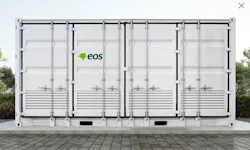
A $1.5 billion strategy to deploy alternative zinc-based long-duration energy storage for commercial, industrial and utility customers is charging ahead and racing past a key financial milestone.
Eos Energy Enterprises announced Thursday that its Frontier Power USA joint venture with Cerberus Capital Management has reached and exceeded its initial capitalization goals through equity and share rights offerings. The $263 million secured so far will strengthen Frontier Power’s push to satisfy about 16 GWh in long-duration battery storage opportunities.
"When we announced Frontier Power USA, we set a target of approximately $250 million in equity raised to capitalize the platform," Eos CEO Joe Mastrangelo said in a statement. "Today that target is expected to be exceeded, funded through our rights offering and commitments from Hudson Bay Capital and Cerberus Capital Management.”
Eos and Cerberus announced the plan to spin off Frontier Power earlier this year. The joint venture, created in 2025, is planned as an independent power producer utilizing Eos’ zinc-based battery technology across multiple sectors, including data centers and utility-scale grid-connected energy storage projects.
The secured capitalization is led by Cerberus’ anchor investment with a $100 million equity commitment, while Hudson Bay Capital Management has committed $75 million toward the project scale-up. The rights offering netted close to $90 million, nearly $15 million more than first expected.
The equity base is anticipated to support more than $1.5 billion of deployable project capital over several years. Frontier Power USA also is working with private equity firm KKR Capital Markets on building a scalable future financing framework to fund new projects.
Last month, Eos announced Frontier Power’s first purchase order under the 2-GWh capacity reservation agreement. The deal supports the 100-MW/400-MWh Redbird energy storage array under development led by Bimergen in the Electric Reliability Council of Texas market.
The Redbird project will use Eos’ Z3 technology. Z3 is a zinc-powered aqueous liquid battery module capable of discharge durations reaching 16 hours and longer, according to the company. Bimergen acquired an array of ERCOT-located battery developments from Aggreko earlier this year.
This market growth positions zinc-based batteries into a group of longer duration alternatives to lithium-ion and lead-acid chemistry. Lithium-ion currently dominates the transportation and stationary energy storage markets with its energy density and daily cycling potential.
Zinc chemistries, however, may also offer high energy and multi-day discharge durations making them attractive as long-term backup power, according to the International Zinc Association’s Zinc Battery Initiative.
Zinc chemistries reportedly stand out more durably to repeated battery cycling and could potentially last up to 20 years, according to the Zinc Battery Initiative.
Battery storage also is increasingly being used at digital infrastructure firms due to its ability in dealing with transient swings of artificial intelligence models.
Eos Energy Enterprises was founded nearly six years ago. Since then, the battery storage firm has deployed its zinc-based alternative in numerous projects, including a 400-MWh order from International Electric Power announced in 2024, a 216-MWh order from City Utilities of Springfield, Missouri, and a deal with Indian Energy in California.
About the Author

Rod Walton, EnergyTech Managing Editor
Managing Editor
For EnergyTech editorial inquiries, please contact Managing Editor Rod Walton at [email protected].
Rod Walton has spent 17 years covering the energy industry as a newspaper and trade journalist. He formerly was energy writer and business editor at the Tulsa World. Later, he spent six years covering the electricity power sector for Pennwell and Clarion Events. He joined Endeavor and EnergyTech in November 2021.
Walton earned his Bachelors degree in journalism from the University of Oklahoma. His career stops include the Moore American, Bartlesville Examiner-Enterprise, Wagoner Tribune and Tulsa World.
EnergyTech is focused on the mission critical and large-scale energy users and their sustainability and resiliency goals. These include the commercial and industrial sectors, as well as the military, universities, data centers and microgrids. The C&I sectors together account for close to 30 percent of greenhouse gas emissions in the U.S.
He was named Managing Editor for Microgrid Knowledge and EnergyTech starting July 1, 2023
Many large-scale energy users such as Fortune 500 companies, and mission-critical users such as military bases, universities, healthcare facilities, public safety and data centers, shifting their energy priorities to reach net-zero carbon goals within the coming decades. These include plans for renewable energy power purchase agreements, but also on-site resiliency projects such as microgrids, combined heat and power, rooftop solar, energy storage, digitalization and building efficiency upgrades.