Rolls-Royce Expands U.S. Manufacturing with $24 Million Mankato Facility
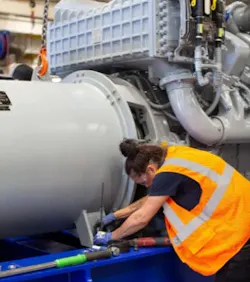
On-site power generation manufacturer Rolls-Royce this week opened its new $24 million facility overseeing the making of diesel generators in Mankato, Minnesota.
The new Logistics Operations Center (LOC) in Mankato is next to the company’s mtu generation manufacturing site. The expansion led by the 250,000-square-foot LOC will help Rolls-Royce more than double its production capacity at the plant to 4,000 mtu Series 4000 generator sets annually.
Those mtu Series 4000 gen-sets are used as on-site backup power for data centers, hospitals, airports and industrial sites. Rolls-Royce Power Systems North America, which is based in Reston, Virginia, says it currently supplies diesel-fired backup power to about 25% of U.S. installed data centers.
Meanwhile, many energy industry experts, including former U.S. Energy Secretary Ernest Moniz, are forecasting that behind-the-meter generation will grow as AI and computing demand rises.
“This investment enables Rolls-Royce to keep pace with the market and provide mission-critical backup power generation at a greater scale than ever before,” Rolls-Royce Power Systems America CEO Jörg Stratmann said in a statement. “Mankato plays an essential role in both the future of Rolls-Royce and U.S. manufacturing – the American-made generators built here power economic activity and critical infrastructure across the Americas.”
Germany-based parent company Rolls-Royce Power Systems was created when British-based Royce-Rolls Plc acquired 100% percent of MTU owner Tognum AG in 2014. Rolls-Royce had owned a joint-venture part of MTU and the Mankato facility for several years prior to that.
The Mankato facility now employs close to 500 people.The Mankato expansion was announced in June 2025, and is part of a greater $100 million investment that Rolls-Royce Power Systems is making across the U.S.
“Rolls-Royce has a deep history in Mankato, and we are proud to demonstrate our continued commitment to grow in and with this community,” Adam Wood, managing editor for Rolls-Royce Solutions America, said. “From the beginning, providing essential power systems for local farmers, to today, where we are producing large-scale generators that support critical infrastructure across the country, the impact of our Mankato facility is defined by the people who keep it running, generation after generation.”
The company last year also announced a $75 million expansion at its facility in Aiken, South Carolina. The mtu Series 4000 engines are built in Aiken and moved to Mankato for assembly with generators.
Rolls-Royce has deployed its mtu Series 4000 standby generators in multiple commercial and industrial sector on-site power projects, including a 2-MW microgrid at Symmetry Park in Biggleswade, United Kingdom.
Mastering Requirements, Standards and Risk
in a Digitally Transformed Energy Sector
Join us for July 21 EnergyTech Webinar with Siemens
Register Free for Live and On-Demand
About the Author
EnergyTech Staff
Rod Walton is head of content for EnergyTech.com. He has spent 17 years covering the energy industry as a newspaper and trade journalist.
Walton formerly was energy writer and business editor at the Tulsa World. Later, he spent six years covering the electricity power sector for Pennwell and Clarion Events. He joined Endeavor and EnergyTech in November 2021.
He can be reached at [email protected].
EnergyTech is focused on the mission critical and large-scale energy users and their sustainability and resiliency goals. These include the commercial and industrial sectors, as well as the military, universities, data centers and microgrids.
Many large-scale energy users such as Fortune 500 companies, and mission-critical users such as military bases, universities, healthcare facilities, public safety and data centers, shifting their energy priorities to reach net-zero carbon goals within the coming decades. These include plans for renewable energy power purchase agreements, but also on-site resiliency projects such as microgrids, combined heat and power, rooftop solar, energy storage, digitalization and building efficiency upgrades.