Evolution PowerX to Deploy Gas Turbine Microgrid for Montney Fracking Ops
Key Highlights
- The microgrid will coordinate multiple gas-fired turbines to supply power across several fracturing sites.
- Evolution PowerX says electrification could improve fracturing efficiency while reducing emissions and noise.
- The Montney is a tight oil and gas formation, distinct from Alberta’s oil sands.
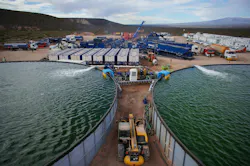
Canadian turbine and distributed power infrastructure developer Evolution PowerX Corp. will deploy a multiple-turbine natural gas microgrid to power hydraulic fracturing drilling operations in the Montney tight oil and gas formation of Alberta.
The producer which will use the microgrid generation has a portfolio of natural gas liquified natural gas operations in the Montney formation. Turbine-generated electrification will both decarbonize and improve fracturing efficiencies across multiple sites, the company said.
“Electrifying multiple aspects of hydraulic fracturing operations represents a significant opportunity for our power solutions business,” Desmond O’Kell, Evolution PowerX’s president and director, said in a statement. “The ability to deliver reliable, scalable electricity across numerous critical applications from a synchronized natural gas turbine platform demonstrates the considerable versatility of our technology.”
Although it’s situated in the same province of Alberta’s oil sands region, the Montney Formation is different geologically and in extraction methodologies. Tight formations are those with oil and gas trapped in microscopic rock pores, whereas oil sands production is a bitumen, tar-like substance sometimes collected through technologies such as steam-assisted gravity drainage.
Although the Evolution PowerX release did not name the Canadian producer contracting the microgrid, among those major operators in the Montney include ARC Resources, Tourmaline and multinationals such as ConocoPhillips, Shell and Petronas.
Oil and gas producers working in remote drilling plays are increasingly moving away from on-site diesel generation to behind-the meter natural gas electrification and microgrids. This change also is happening in the prolific Permian Basin of the southwest U.S.
In the Evolution PowerX solution, multiple gas-fired turbines fed by local supply will generate power in coordination through a synchronized microgrid. This solution will seek to lower emissions and noise levels while improving fuel efficiency, the company says.
Enterprise Group restructured and renamed itself Evolution PowerX earlier this summer to focus on gas-fired distributed energy solutions.
About the Author
 Rod Walton, EnergyTech Managing Editor
Managing Editor
For EnergyTech editorial inquiries, please contact Managing Editor Rod Walton at [email protected].
Rod Walton has spent 17 years covering the energy industry as a newspaper and trade journalist. He formerly was energy writer and business editor at the Tulsa World. Later, he spent six years covering the electricity power sector for Pennwell and Clarion Events. He joined Endeavor and EnergyTech in November 2021.
Walton earned his Bachelors degree in journalism from the University of Oklahoma. His career stops include the Moore American, Bartlesville Examiner-Enterprise, Wagoner Tribune and Tulsa World.
EnergyTech is focused on the mission critical and large-scale energy users and their sustainability and resiliency goals. These include the commercial and industrial sectors, as well as the military, universities, data centers and microgrids. The C&I sectors together account for close to 30 percent of greenhouse gas emissions in the U.S.
He was named Managing Editor for Microgrid Knowledge and EnergyTech starting July 1, 2023
Many large-scale energy users such as Fortune 500 companies, and mission-critical users such as military bases, universities, healthcare facilities, public safety and data centers, shifting their energy priorities to reach net-zero carbon goals within the coming decades. These include plans for renewable energy power purchase agreements, but also on-site resiliency projects such as microgrids, combined heat and power, rooftop solar, energy storage, digitalization and building efficiency upgrades.