$30M Seed Round Bolsters Voltify's Rail E-Mobility Idea Linking Sodium-Ion Batteries and Charging Microgrids
U.S. railway carriers transport close to half of the nation’s commercial and industrial freight volumes, accounting for nearly $250 billion in annual economic activity.
They also generate significant energy costs and emissions. Top railway movers like Burlington Northern Santa Fe, CSX and Union Pacific spend more than $11 billion annually on diesel fuel to drive those traditional train engines.
A new startup dedicated to electrifying rail transport through on-board battery power is gaining financial traction with $30 million raised in its seed funding round. Philadelphia-based Voltify gained financing to advance its rail battery solution in the seed round co-led by venture capital investor Aleph and global mining company Fortescue.
Some railways, particularly in Europe, are electrifying through the overhead wire route. Such an overhaul in the U.S., however, might cost $1 trillion in capital investment upgrades, a forbidding number even in an industry which enjoys a broader profit margin and fuel efficiency than other logistics and transport sectors.
Many Paths to Net Zero in C&I Enegy Transition
Follow ET on LinkedIn
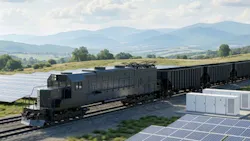
Voltify’s founders are designing the platform to get around that infrastructure barrier by combining battery-powered locomotives with fast-charging technology and a network of renewable microgrids along rail routes.
“We built Voltify to solve one of the rail industry’s biggest challenges: energy costs,” Daphna Langer, who co-founded the startup with Alon Kessel, said in a statement. “Our platform allows rail companies to access clean, affordable energy without changing the way they operate. If you can reduce energy costs by even 5%, it’s huge. If you can reduce them by more than 20%, it becomes transformative.”
Voltify makes the case that its distributed-energy platform ultimately can reduce freight rail fuel costs by 20% without costly infrastructure investment by the major rail operators. The company’s “Voltcars,” which are designed to be longer duration sodium-ion batteries on wheels—would be connected to existing locomotives.
“Converting six companies is not that hard. And having that ability to create such an impact with just six companies, it’s huge,” Langer said in an August 2025 interview with cable business channel CNBC. “There is almost 140,000 miles of freight railroad track in the U.S., with the majority of the locomotives powered by diesel as there is little overhead electrification.
She founded Voltify three years ago with Kessel, a renewables sector veteran who previously started clean energy project developer Doral Group. Diesel costs and air pollution are concerning issues to the Class I railroad operators, but the upfront costs and worries over battery charging times are another hurdle to leap for Voltify.
Trucking is still the most consumptive freight sector with more than 5 quadrillion British thermal units of energy burned in 2023, according to U.S. Department of Transportation statistics. Class I rail operators using distillates and diesel burned less than 1/10th of that amount in Btus, but on average consumed close to the trucking industry’s same energy intensity per car mile, according to U.S. DOT.
“Our goal is to lower energy costs by over 20%; this is not just the diesel costs, but all the next energy that the industry needs,” Langer said. “Rail companies shouldn’t have to choose between sustainability and economics. We’re making clean energy the financially smarter option.”
Voltify’s microgrids would be designed and installed to use locally sourced solar power, batteries, and advanced energy management software. Mining firms such as Fortescue already are exploring electrification of both on-site trucking and rail services in some of their global operations.
“Fortescue is committed to investing in the research and development of innovative technologies to drive real zero and accelerate decarbonization across our operations and beyond,” Gus Pichot, CEO of growth and energy at Fortescue, said. “Voltify’s mission to eliminate emissions in the heavy rail industry aligns with ours at Fortescue, and we’re encouraged by the solutions they are working on.”
Other investment firms contributing to Voltify’s $30 million seed round include Menomadin, J-Impact, The Dock and E44.
A New Era of Energy Efficiency
Innovations for Today and Tomorrow/New White Paper by Ameresco
About the Author
 Rod Walton, EnergyTech Managing Editor
Rod Walton, EnergyTech Managing Editor
Managing Editor
For EnergyTech editorial inquiries, please contact Managing Editor Rod Walton at [email protected].
Rod Walton has spent 17 years covering the energy industry as a newspaper and trade journalist. He formerly was energy writer and business editor at the Tulsa World. Later, he spent six years covering the electricity power sector for Pennwell and Clarion Events. He joined Endeavor and EnergyTech in November 2021.
Walton earned his Bachelors degree in journalism from the University of Oklahoma. His career stops include the Moore American, Bartlesville Examiner-Enterprise, Wagoner Tribune and Tulsa World.
EnergyTech is focused on the mission critical and large-scale energy users and their sustainability and resiliency goals. These include the commercial and industrial sectors, as well as the military, universities, data centers and microgrids. The C&I sectors together account for close to 30 percent of greenhouse gas emissions in the U.S.
He was named Managing Editor for Microgrid Knowledge and EnergyTech starting July 1, 2023
Many large-scale energy users such as Fortune 500 companies, and mission-critical users such as military bases, universities, healthcare facilities, public safety and data centers, shifting their energy priorities to reach net-zero carbon goals within the coming decades. These include plans for renewable energy power purchase agreements, but also on-site resiliency projects such as microgrids, combined heat and power, rooftop solar, energy storage, digitalization and building efficiency upgrades.