Mapping the Road Ahead: EV Charging Infrastructure Gaining Speed Nationwide
Key Highlights
- - The U.S. has nearly 15,000 EV charging stations and 70,000 ports, with 17,000 new fast-charging stalls added since early 2025.
- - The Department of Energy predicts a need for 28 million charging points by 2030 to support the anticipated 33 million EVs on the road.
- - EV adoption continues to grow, supported by infrastructure build-out, despite policy setbacks like the loss of tax credits.
Keep your eyes on the road. Things are shifting into a higher gear around you.
What does that even mean? The death of electric vehicles in the United States has been greatly exaggerated.
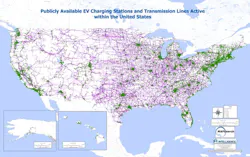
In fact—and despite losing long-time tax credits killed in the recent One Big Beautiful Bill Act and some automakers walking back EV model plans—EV adoption, fleet electrification and charging infrastructure are aggregating at a level to make this impressive map above.
Look around on the highway and byways in the U.S. and you might see more Nissan Leafs, Hyundai Ioniqs, electric buses and, yes, Teslas. They are out there more than ever.
Look at this map above: it shows the density and proximity of EV charging stations and energized line connections across the U.S. and was developed by MAPSearch through its proprietary database. MAPSearch is a long-term data service provider for the energy and industrial sectors and, like EnergyTech, is part of parent company Endeavor B2B.
The map proves that EV infrastructure density is growing. Otherwise, way put the cartography before the horsepower?
The EVChargingStations.com website in January estimated that the U.S. now has nearly 15,000 stations and nearly 70,000 EV charging ports. Charging time is as much a concern for potential EV buyers as range fear, so the EVChargingStations site notes that nearly 17,000 public direct-current (DC) fast-charging stalls have been added since early 2025, with more than 40 new DC fast-charging stalls added every day.
Today, EnergyTech.com reports that EV infrastructure firm ChargePoint has developed more than 90 new charging ports in southern California for the South Coast Air Quality Management District. ChargePoint is also working with power management firm Eaton to develop a wide array of charging options throughout the nation. California is a focal point because it is still the biggest U.S. market for EVs.
“Together with South Coast AQMD, ChargePoint is deploying accessible and reliable charging options for communities within America’s largest EV market,” said Rick Wilmer, CEO at ChargePoint, said earlier this week. “Having enabled more than 21 billion electric miles to date, ChargePoint shares South Coast AQMD’s values and directly supports its mission to reduce greenhouse gas emissions and improve air quality.”
The AQMD project replaced outdated chargers with 55 new, Level 2 ChargePoint units capable of serving 94 vehicles simultaneously, including multiple ChargePoint CP6000 charging stations. The CP6000 delivers 60% faster charging than a typical Level 2 station and features ChargePoint’s Omni Port connector system, allowing any modern EV to charge without an adapter.
The MAPSearch database utilizes charging station locational mapping from sources such as ChargePoint and also Electrify America. It also was developed in partnership with research solutions firm Endeavor Business Intelligence.
The National Laboratory of the Rockies (previously known as the National Renewable Energy Laboratory) has tracked EV charging rollouts for many years, utilizing Department of Energy data collected in partnership with the Clean Cities Coalition.
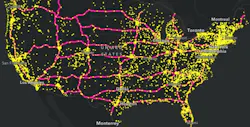
The momentum behind EV charging infrastructure isn’t new, of course, and has been expanding for more than a decade. A 2022 map by ESRI highlighted the density of EV charging at that time, with the greater frequency of station locations concentrated mainly along the east and west coasts.
As MAPSearch shows, the picture has broadened out considerably. Even the U.S. DOE predicts that by 2030, the nation will require 28 million EV charging points to support 33 million electric vehicles on the road.
Not all of those must go find a station, as they can be charged at home for a fraction of the cost of gas for the internal combustion vehicle at the local convenience store. What these updates and projections indicated, however, is that EV adoption and the infrastructural build-out around that are still moving in the fast lane.
About the Author

Rod Walton, EnergyTech Managing Editor
Managing Editor
For EnergyTech editorial inquiries, please contact Managing Editor Rod Walton at [email protected].
Rod Walton has spent 17 years covering the energy industry as a newspaper and trade journalist. He formerly was energy writer and business editor at the Tulsa World. Later, he spent six years covering the electricity power sector for Pennwell and Clarion Events. He joined Endeavor and EnergyTech in November 2021.
Walton earned his Bachelors degree in journalism from the University of Oklahoma. His career stops include the Moore American, Bartlesville Examiner-Enterprise, Wagoner Tribune and Tulsa World.
EnergyTech is focused on the mission critical and large-scale energy users and their sustainability and resiliency goals. These include the commercial and industrial sectors, as well as the military, universities, data centers and microgrids. The C&I sectors together account for close to 30 percent of greenhouse gas emissions in the U.S.
He was named Managing Editor for Microgrid Knowledge and EnergyTech starting July 1, 2023
Many large-scale energy users such as Fortune 500 companies, and mission-critical users such as military bases, universities, healthcare facilities, public safety and data centers, shifting their energy priorities to reach net-zero carbon goals within the coming decades. These include plans for renewable energy power purchase agreements, but also on-site resiliency projects such as microgrids, combined heat and power, rooftop solar, energy storage, digitalization and building efficiency upgrades.