EV Charging Industry Evolving and Adapting as Commercial and Residential Demand Grows
Keep your eyes on the road ahead. Big changes are closer than they appear.
Electric vehicles in the United States are both a beneficiary and victim of high expectations and conflicting ambitions over the past decade. The EV market flourished due to tax credits and volatile oil and gas markets in the late 2010s and early to mid-2020s.
Many forecast the doom of EVs after the One Big Beautiful Bill Act killed long-running incentives, and yet the War with Iran and other energy volatilities kept attracting new drivers to battery-powered automobiles.
No doubt that EVs are here to stay in the U.S. and electrification continues to grow nationwide despite a current uptick in fossil fuel consumption. Look around you on the road and you’ll see more Tesla Ys, more Ioniq 5s, not to mention the coming new-model Leafs and Bolts.
EV charging infrastructure keeps pace as it must. The acceleration is undeniable.
Projects by ElectrifyAmerica, Evgo, ChargePoint, ABB, Blink and Schneider Electric are creating a nationwide network which is bringing a positive reality to check range fears, convenience concerns and other headwinds against EV adoption.
From land grab to building singular charging experiences

The key early on was quantity to get as many charging stations and sites secured as possible. The focus now is to locate those chargers in convenient spots in route to popular destinations and make the experience as quick and enjoyable as possible.
“In my perspective, the industry has evolved over time,” said Shawn Bonacorsi, Head of Electrification Solutions at Schneider Electric, North America Operations. Prior to joining Schneider Electric, Bonacorsi spent 13 years at General Motors, including leadership roles in the company’s EV, charging and energy businesses.
“Once it was a land grab and trying to get as many (locations) as possible,” Bonacorsi added in an exclusive interview with EnergyTech.com. “The evolution you’re seeing is from a land grab to the quality aspect—making sure the charging experience is a great one.”
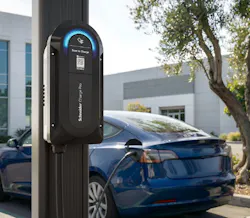
The new Schneider Electric Charge Pro commercial EV charger was launched last month. Charge Pro is a Level 2 solution which offers faster smart charging and is designed for workplaces, multifamily properties and destination charging locations—all sectors which are increasingly growing in EV adoption, according to statistics.
“We’ve seen specifically strong growth in the commercial space,” Bonacorsi pointed out. “It’s across the board; it’s multi-family and all commercial settings. A large amount of investment is going into public charging, which is great. In new developments, the focus is on the Level 2 space, and that’s where we see great opportunity.”
Next-level charging buildout is racing ahead
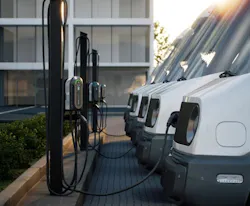
A Level 2 charger is equipment which offers higher-rate AC power through 240-volt and 208-volt electrical service, according to the U.S. Department of Transportation. This type of supply and connection can charge a battery-electric vehicle from zero to 80% in several hours, which is ideal for homes and workplaces. Direct-current fast charging offers the best capacity and speed for long-distance EV drivers at travel centers.
A National Renewable Energy Laboratory (now National Laboratory of the Rockies) report from several years ago pinpointed the need for Level 1 and 2 charging infrastructure to accelerate EV adoption on a localized level. NREL’s National Charging Network Report forecasted the need for millions of charging ports across the nation by the 2030s.
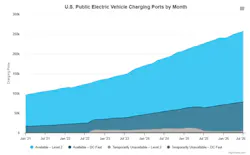
That's the ambitious part mentioned at the start of this story. The real number at this current moment is closer to 250,000 public charging ports, but if that’s a far cry from millions it’s still a 150% increase from January 2021, according to a chart at DriveElectric.com.
A recent annual global review from the London-based Energy Institute showed China outpacing its U.S. economic rivals in both total electrification and EV growth. This embrace of electrification is also decreasing China’s world-worst carbon intensity of its energy supply, while the U.S. is regressing slightly.
Nonetheless, electrification and EV infrastructure buildout are still gathering forces in the U.S.
“The U.S. is definitely on pace in the sense of electrification,” Schneider Electric’s Bonacorsi told EnergyTech. “It may be lagging China in some indicators and in others maybe not. With respect to charging infrastructure, obviously China is well ahead of the U.S. and Europe … But it hasn’t slowed in the U.S., and we’re seeing month-over-month growth in electrification, month-over-month growth in EV charging infrastructure and adoption.
“We are trending in the right direction,” Bonacorsi added.
EV adoption momentum shifting into passing lane
Bonacorsi is clearly encouraged by seeing massive growth in commercial real estate installations of Level 2 and public charging, as well as residential multi-family properties.
Bonacorsi is not alone in that, which proves the justification in Schneider Electric’s persistent investment priorities around EV charging infrastructure. The EV infrastructure installation pace at U.S. commercial properties is growing at about 25% or higher per year, according to the International Council on Clean Transportation (ICCT) report in April 2025. This indicates a doubling of total installations every three years.
“Charging deployment has not been uniform across the United States, and more chargers have been deployed in states with the most EV sales,” read the ICCT report. “Publicly announced investments in charging infrastructure from retailers, automakers, and charging providers sum up to 164,000 new DC fast chargers and 1.5 million new Level 2 chargers in the years ahead. These investments cover a substantial share of the chargers that we estimate will be needed by 2030.”
Schneider Electric’s most recent project announcement was its collaboration with energy-as-a-service provider Budderfly to build out microgrid and EV charging technology for the city of Cadillac, Michigan. The project, which is part of the Schneider and Microsoft-led Accelerating Resilient Infrastructure Initiative, will include Charge Pro Level 2 charging behind the microgrid.
This kind of correlated projects such as the city of Cadillac hint at the future of electrification in the U.S. and elsewhere. These are projects which integrate lower carbon on-site power, building electrification, energy efficiency and EV charging infrastructure.
It’s not about the land grab, Bonacorsi noted. It’s about creating a more seamless experience.
“Planning ahead is what is going to win the next phase,” he said. “You’ve got to plan intelligently around it.”
About the Author

Rod Walton, EnergyTech Managing Editor
Managing Editor
For EnergyTech editorial inquiries, please contact Managing Editor Rod Walton at [email protected].
Rod Walton has spent 17 years covering the energy industry as a newspaper and trade journalist. He formerly was energy writer and business editor at the Tulsa World. Later, he spent six years covering the electricity power sector for Pennwell and Clarion Events. He joined Endeavor and EnergyTech in November 2021.
Walton earned his Bachelors degree in journalism from the University of Oklahoma. His career stops include the Moore American, Bartlesville Examiner-Enterprise, Wagoner Tribune and Tulsa World.
EnergyTech is focused on the mission critical and large-scale energy users and their sustainability and resiliency goals. These include the commercial and industrial sectors, as well as the military, universities, data centers and microgrids. The C&I sectors together account for close to 30 percent of greenhouse gas emissions in the U.S.
He was named Managing Editor for Microgrid Knowledge and EnergyTech starting July 1, 2023
Many large-scale energy users such as Fortune 500 companies, and mission-critical users such as military bases, universities, healthcare facilities, public safety and data centers, shifting their energy priorities to reach net-zero carbon goals within the coming decades. These include plans for renewable energy power purchase agreements, but also on-site resiliency projects such as microgrids, combined heat and power, rooftop solar, energy storage, digitalization and building efficiency upgrades.