Santa Monica's DOT Begins Work Toward $56M Big Blue Electric Bus Charging Infrastructure
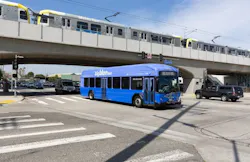
The Santa Monica Department of Transportation is driving toward bigger and bluer destinations with its $56 million plan to transition its public mobility fleet to a fully zero-emission Big Blue Bus fleet in six years.
The multi-modal transportation service recently has retained e-mobility partners ChargePoint and Eaton to deliver integrated electric vehicle (EV) charging and power infrastructure toward that goal. The Big Blue Bus rollout is designed for full integration by 2026 and will deploy 130 direct-current (DC) fast-charging ports and necessary power management technologies.
Eaton will provide the latter, which includes medium-voltage switchgear, switchboards, panelboards and engineering expertise to manage electricity flow. The 130 DC fast-charging ports consist of ChargePoint’s Express Plus equipment line.
“The Santa Monica project is a powerful example of how we're helping customers turn ambitious electrification goals into reality,” said Paul Ryan, vice president and general manager, Energy Transition at Eaton, in a statement.
Santa Monica DOT broke ground on its $56-million e-mobility infrastructure project nearly five months ago. Construction is beginning with installing overhead gantry charging systems capable of powering up to 195 battery-electric buses. The Big Blue Bus program currently has 34 of those zero-emissions buses in operation.
EnergyTech covers the World of C&I Energy Transition
Follow us on LinkedIn
“By investing in clean, electric transit, we’re creating healthier air for our communities, a quieter and more comfortable experience for riders, and a safer, more efficient environment for our workforce,” said Anuj Gupta, director of transportation for the city of Santa Monica. “This collaboration will introduce innovative charging solutions that enable reliable and affordable service delivery for more than 10 million Big Blue Bus rides each year.”
The Big Blue Bus electric vehicle expansion is mostly funded through a $53.3 million grant from the statewide California Transit and Intercity Rail Capital Program.
Last year, intelligent energy management firm Eaton and ChargePoint announced their collaboration to advance EV charging infrastructure throughout the U.S., Canada and Europe. The partnership enables both companies to co-develop new technologies advancing bidirectional power low and vehicle-to-everything (V2X) capabilities which can also turn EVs into mobile microgrids.
“Santa Monica’s leadership in clean transportation demonstrates what’s possible when cities commit to bold climate action,” said Rick Wilmer, CEO at ChargePoint, in a statement. “This project represents one of ChargePoint’s largest transit deployments to date, showcasing how our scalable, high-power charging solutions can meet the complex needs of large bus fleets and help agencies transition to fully electric operations while delivering a lower total cost of ownership.”
ChargePoint’s fleet software will advance monitoring of the electric bus fleet, both on routes and at the depot, making any necessary changes in real-time and reporting on sustainability results. Some of the key challenges for EV charging impact voltage and grid instability.
The Santa Monica DOT Big Blue Bus integration is the latest of Eaton’s multiple power management projects in California, including work at 35 healthcare facilities statewide.
Eaton’s Ryan and ChargePoint CEO Wilmer detailed their collaboration when speaking with EnergyTech.com and Microgrid Knowledge at last year’s RE+ Conference in Las Vegas. The scale needed for widespread infrastructural change requires partnerships, they agreed.
“To really scale electrification, you need collaboration across industries,” Ryan said. “I don’t believe any company can do this on its own.”
The two companies united after discussing more energy-efficient paths toward DC and V2X technologies in the years ahead.
“We’re integrating charging in a more technologically advanced way with the grid and with vehicles, and by doing so we can unlock all kinds of value,” Wilmer said at RE+. “The amount of cars you can charge, in a limited footprint, goes way, way up. You can save 30% on capital expenditures, reduce operational expenditures 30%. . . And in 30% less physical footprint.”
By shifting the charging dynamic from AC to DC and filling it with DC-DC, the power of a charging cabinet can be expanded beyond 1 MW, he added.
State of Market Report: Power Quality Fluctuations
New White Paper by Ubicquia
About the Author
 Rod Walton, EnergyTech Managing Editor
Rod Walton, EnergyTech Managing Editor
Managing Editor
For EnergyTech editorial inquiries, please contact Managing Editor Rod Walton at [email protected].
Rod Walton has spent 17 years covering the energy industry as a newspaper and trade journalist. He formerly was energy writer and business editor at the Tulsa World. Later, he spent six years covering the electricity power sector for Pennwell and Clarion Events. He joined Endeavor and EnergyTech in November 2021.
Walton earned his Bachelors degree in journalism from the University of Oklahoma. His career stops include the Moore American, Bartlesville Examiner-Enterprise, Wagoner Tribune and Tulsa World.
EnergyTech is focused on the mission critical and large-scale energy users and their sustainability and resiliency goals. These include the commercial and industrial sectors, as well as the military, universities, data centers and microgrids. The C&I sectors together account for close to 30 percent of greenhouse gas emissions in the U.S.
He was named Managing Editor for Microgrid Knowledge and EnergyTech starting July 1, 2023
Many large-scale energy users such as Fortune 500 companies, and mission-critical users such as military bases, universities, healthcare facilities, public safety and data centers, shifting their energy priorities to reach net-zero carbon goals within the coming decades. These include plans for renewable energy power purchase agreements, but also on-site resiliency projects such as microgrids, combined heat and power, rooftop solar, energy storage, digitalization and building efficiency upgrades.